FREE LARGE PROJECT CONSULTATION
CLICK HERE to schedule an appointment with our lighting expert.
5% OFF ANY ORDER Use Code: SUPER5OFF

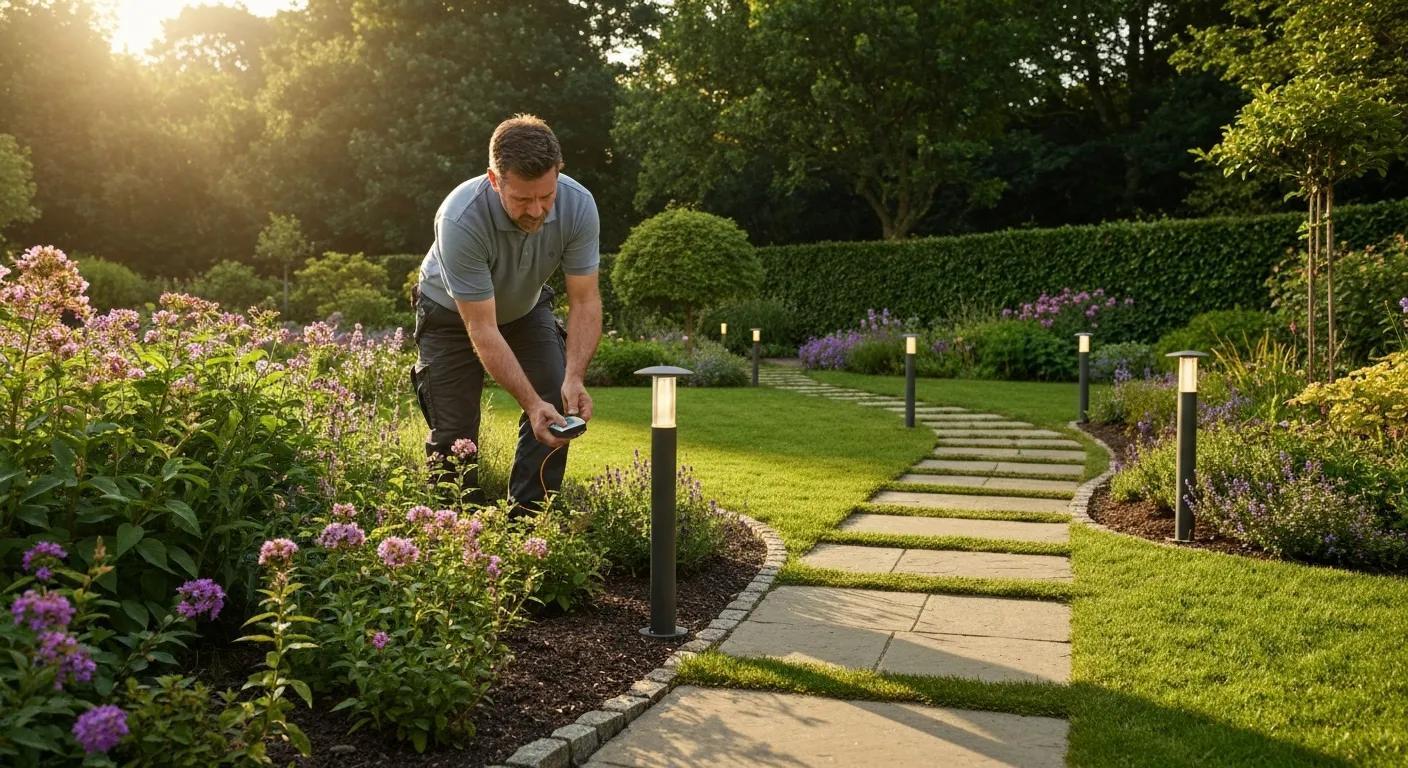
Remote-Controlled Garden Lighting Systems: Complete Guide to Smart Outdoor Lighting Control

Remote-controlled garden lighting lets you manage outdoor illumination for security, ambiance, and energy savings from a single controller or app. This guide covers the core parts of these systems, how wireless options like Wi-Fi, Bluetooth, RF, and solar influence performance, and what to consider when planning or installing low-voltage lighting. You will also find simple setup steps, troubleshooting tips, and helpful comparison points so you can choose and configure the right remote-controlled garden lighting system for your space.
What Are Remote-Controlled Garden Lighting Systems and How Do They Work?
Remote-controlled garden lighting systems are assemblies of outdoor fixtures, a control unit, and a power source that work together so you can switch, dim, schedule, or change scenes remotely. The core mechanism pairs a controller (such as an app, RF remote, or hub) with lighting fixtures through wired low-voltage connections or wireless links, allowing commands to be translated into switched voltage, dimming levels, or color control. The benefit is precise runtime control that reduces energy use, increases security, and creates repeatable ambiance without manual switching.
Below is a compact comparison of common control technologies to clarify which approach fits different gardens and connectivity needs.
| Control Technology | Typical Range / Connectivity | Best Use Case |
|---|---|---|
| RF (Radio Frequency) | 30–300+ ft (line-of-sight); local handset or keyfob | Simple long-range remote control without home Wi-Fi |
| Wi-Fi | Depends on home router, 100+ ft with extenders; app/cloud control | App-based control, scheduling, and voice integration |
| Bluetooth | 30–50 ft typical; direct device pairing | Small patios or point-to-point control where local pairing suffices |
| Solar (integrated) | Independent per-fixture; local sensor/remote pairing varies | Off-grid spots or easy installs with no trenching |
This comparison shows RF excels for reliable long-range switching while Wi-Fi enables advanced scenes and cloud features; the next subsections unpack each technology and then compare them more directly for decision-making.
Which Remote Control Technologies Are Used in Garden Lighting?
Remote-controlled garden lighting commonly uses RF remotes, Wi-Fi-enabled controllers, Bluetooth direct pairs, and solar-integrated control modules, each providing different installation models and user experiences. RF systems send radio commands to a receiver connected to the transformer or controller, offering simple pairing and extended range but limited cloud features. Wi-Fi controllers connect fixtures or the controller to a home network, enabling app scheduling, color control, and voice assistants at the cost of dependence on router range and internet availability. Solar kits rely on on-board solar charging and local control logic or lightweight remotes, making them ideal where mains power is unavailable. Understanding these trade-offs helps select the technology that aligns with range requirements, integration goals, and the physical layout of the garden.
Efficient Remote Control with Wi-Fi for Outdoor Lighting
Wi-Fi is a popular technology that allows electronic devices to connect to the internet or exchange data wirelessly using RF.
Efficient remote control system using SMS and WiFi technology for outdoor security lighting applications, MF Akorede, 2017
How Do Wireless Controls Like Wi-Fi, Bluetooth, and RF Compare?
Wi-Fi, Bluetooth, and RF differ primarily in range, latency, setup complexity, and smart-home friendliness, which determines suitability for different landscape layouts. Wi-Fi integrates well with apps and voice platforms and supports cloud features, but can suffer from dead zones outdoors unless extenders or outdoor access points are used. Bluetooth is simple to pair and avoids router dependency but is limited by short range and single-user control, making it best for compact patios or deck string lights. RF offers a robust range and minimal latency and can operate independently of a network, but it often lacks the advanced scheduling or multi-user cloud features that Wi-Fi provides. Considering interference, RF can be affected by dense foliage and structures, while Wi-Fi faces competition from neighboring networks and 5 GHz/2.4 GHz band choices, so site survey and placement planning remain essential.
Wi-Fi: The Widely Deployed Wireless Technology for Smart Devices
Nowadays, Wi-Fi is the technology used by most and is widely deployed in homes, offices, coffee shops and airports, etc. It is also widely used with smart phones, tablets and smart TVs, etc.
An extensive comparison of the next generation of wireless communication technology: Light-fidelity (Li-Fi) versus wireless-fidelity (Wi-Fi), MA Shuriji, 2014
What Are the Key Benefits of Smart Outdoor Lighting Systems?

Smart outdoor lighting delivers three primary benefits: improved security through automation and presence simulation, measurable energy savings from LEDs and scheduling, and enhanced ambiance via dimming and color control. The mechanism behind these benefits is simple: automation and sensors reduce unnecessary runtime, LED fixtures lower wattage for equivalent light output, and programmable scenes let you shape the visual character of outdoor spaces. Working with Light Disty products ensures high-quality LEDs and controllers that maximize these benefits.
| Feature | How It Works | Benefit / Example |
|---|---|---|
| Scheduling | Controller runs lights by time or sunset/sunrise | Reduces runtime, simulates presence, lowers energy use |
| Motion Sensors | Triggers high output on detection, holds low ambient otherwise | Enhances security, directs light only when needed |
| Dimming & Scenes | Variable voltage or PWM signal controls brightness/color | Creates ambiance and cuts consumption during non-peak hours |
| Remote App Control | Cloud or local app toggles and automations | Immediate control and remote monitoring from anywhere |
How Does Remote Control Enhance Security and Safety in Gardens?
Remote-controlled lighting enhances security by enabling motion-triggered brightening, randomized schedules for presence simulation, and instant remote activation during an emergency. Motion sensors feed into controllers that temporarily increase brightness when activity is detected, deterring intruders while maintaining low-power baseline lighting the rest of the time. Scheduling can mimic occupancy patterns by turning lights on and off at different times each night, which is more effective than static timers. Integration with cameras or alarms allows lighting events to trigger recordings or alerts, creating an orchestrated security response that improves visibility and reduces false negatives during nighttime events.
How Do Smart Garden Lights Improve Energy Efficiency and Cost Savings?
Smart garden lights reduce energy use primarily by combining efficient LED fixtures with automation that shortens runtime and avoids full-power operation when unnecessary. LEDs deliver far more lumens per watt than halogen or incandescent sources, and dimming or motion-triggered control further reduces consumption during idle periods. For typical landscape installations, replacing halogen path lights with LED equivalents and enabling schedules can reduce annual lighting energy use by 40–70%, depending on runtime patterns. The practical approach is to pair LED fixtures rated in lumens rather than watts with controllers that support dimming and scheduling so you get both the light quality you need and measurable cost savings over time.
How Do You Install and Set Up Remote-Controlled Garden Lighting Systems?
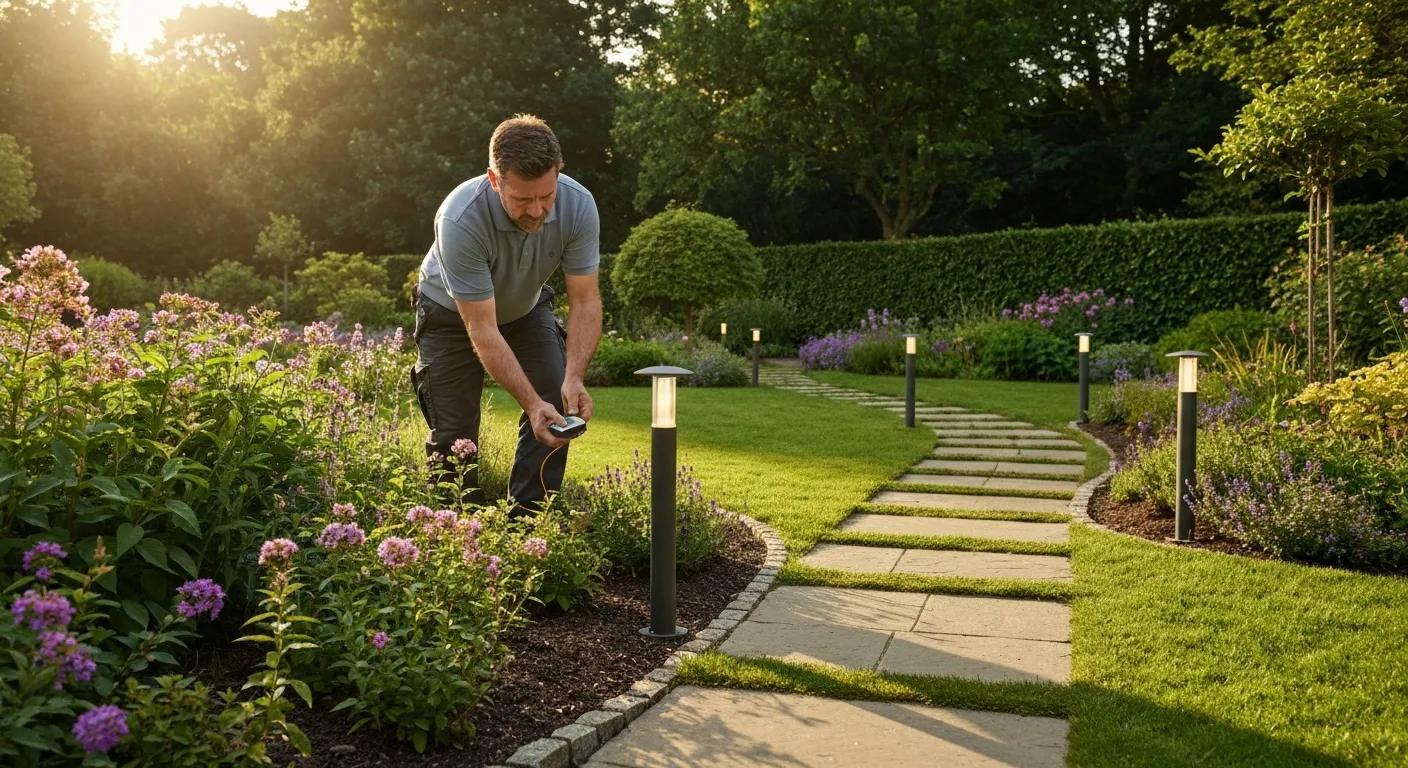
Installing remote-controlled garden lighting involves planning fixture placement and voltage drop, running low-voltage wiring to fixtures, installing a properly sized transformer, and then pairing or configuring the controller and app. The first step is a site plan showing fixture types, distances to the transformer, and desired control zones so you can calculate VA requirements and wire gauge. Next comes safe trenching or surface routing of cable, waterproof connector use, and mounting fixtures with corrosion-resistant fasteners. After power-up, pairing the controller or remote, setting zones and schedules, and verifying operation under actual night conditions completes the setup. Below are compact, numbered installation steps you can follow as a checklist.
- Plan layout: map fixture locations, run lengths, and desired zones.
- Calculate power: sum the LED VA, add a safety margin, and choose the transformer VA accordingly.
- Choose wire gauge and route cable: use recommended low-voltage wire and protect with conduit where necessary.
- Mount fixtures and connectors: use IP-rated fixtures and waterproof connectors.
- Connect the transformer and controller: observe polarity and ground, then pair controllers or app.
- Test and adjust: run nighttime tests to adjust beam angles and schedule settings.
What Are the Steps for Planning and Wiring Low-Voltage Outdoor Lights?
Planning and wiring low-voltage lights starts with calculating total VA, choosing the correct transformer size, and selecting the wire gauge to limit voltage drop across runs. As a rule of thumb, add a 20–25% safety margin to the summed VA of all LEDs when sizing a transformer to avoid overload and allow future expansion. Wire gauge selection depends on run length and load; longer runs require larger gauge cable to keep voltage drop within acceptable limits and preserve brightness at the farthest fixtures. Use GFCI-protected circuits for the transformer supply, waterproof connectors at every splice, and bury cable at local code depths or run through conduit for exposed runs. Careful planning ensures reliable brightness, simplifies troubleshooting, and reduces the chance of premature fixture failure.
How Do You Connect and Configure App-Controlled Landscape Lighting?
Connecting app-controlled landscape lighting usually follows a standard pairing sequence: power the controller, put the controller into pairing mode, use the app to detect the device (often on the 2.4 GHz band), create zones, and assign schedules or scenes. Common pairing pitfalls include being connected to a 5 GHz Wi-Fi network (many controllers require 2.4 GHz), incorrect password entry, or firewall settings that block device discovery, so ensure your mobile device is on the same frequency during setup. After pairing, create logical zones (front path, backyard, accent) and program sunset/sunrise triggers, motion overrides, and energy-saving dim levels. Keep firmware updated and secure the account with a strong password, as cloud-dependent systems require regular updates to maintain compatibility and security.
How Can You Integrate Remote-Controlled Garden Lights with Smart Home Ecosystems?
Integrating garden lights with smart-home ecosystems adds voice control, coordinated routines, and broader automation across devices by connecting controllers to platforms such as common voice assistants or hub systems. The integration mechanism varies: some controllers expose devices directly to voice assistants via cloud accounts, while hub-based ecosystems link devices locally for faster automations. Decide whether you prefer cloud features like remote access or local processing for privacy and resilience, and match that preference to controllers that advertise cloud or local modes. After integration, you can build routines that tie lighting scenes to door sensors, weather events, or geofencing-based presence for a seamless outdoor lighting experience.
Which Voice Assistants Work Best with Smart Garden Lighting?
Voice assistants provide quick control of outdoor lights, including on and off commands, brightness adjustments, and scene changes, with the capability varying by controller integration. Alexa and Google Assistant offer broad third-party support, strong routine features, and simple commands such as “turn on garden path” or “set backyard to 50 percent.” Siri and HomeKit focus on privacy and reliable local automation but require HomeKit-compatible controllers, which can narrow product options. When selecting a voice assistant, check which commands your controller supports and whether it allows zone-level access and scene control, since these features determine how precisely you can manage outdoor lighting tasks like dimming accent fixtures or switching motion modes.
How Do Apple HomeKit and Samsung SmartThings Enhance Outdoor Lighting Control?
Apple HomeKit and Samsung SmartThings differ in approach: HomeKit emphasizes local automations and privacy with tight integration for scenes and automations, while SmartThings offers broad device compatibility and hub-based routing for diverse ecosystems. HomeKit’s local routines shine when you want reliable, router-independent scene execution at sunset or geofence events without cloud reliance. SmartThings supports many hub-connected devices and advanced rule builders for complex automations that link lighting to sensors, cameras, and other accessories. Choose HomeKit for privacy-focused, deterministic automations and SmartThings for flexible multi-vendor networks; in both cases, confirm outdoor controller compatibility and whether the ecosystem supports the specific zone or dimming features you need.
What Should You Consider When Choosing the Best Remote-Controlled Garden Lighting System?
When choosing a system, prioritize durability (IP rating and corrosion resistance), power options (low-voltage vs solar), scalability (multi-zone support), user experience (intuitive app and firmware updates), and spec clarity (transformer VA, wire gauge recommendations, LED lumens). Durability ensures fixtures endure moisture, salt, and temperature swings, while clear specs make installation predictable and future expansion feasible. A user-friendly app that provides reliable schedules, firmware updates, and local fallback control reduces maintenance headaches over time.
| Component | Spec to Check | Recommended Value / Range |
|---|---|---|
| IP Rating | Ingress protection for fixtures | IP65 or higher for exposed areas |
| Transformer | VA capacity relative to total LED load | Sum VA × 1.25 safety margin |
| Wire Gauge | AWG for run length | 12–16 AWG depending on distance and load |
| LED Output | Lumens per fixture | Match lumens to intended task (path vs spot) |
How Important Are Durability and Weather Resistance for Outdoor Lights?
Durability and weather resistance matter greatly because outdoor fixtures must withstand moisture, UV exposure, freeze-thaw cycles, and salt corrosion in coastal environments, all of which influence lifespan and safety. An IP65 rating protects against water jets and dust for most landscape applications, while IP67 adds temporary immersion protection for more demanding sites. Material choices such as stainless steel, powder-coated die-cast aluminum, and UV-stable plastics shape corrosion resistance, structural stability, and heat management, which directly impact LED longevity. Choosing the right IP rating and corrosion-resistant mounts reduces maintenance frequency and helps fixtures maintain their optical performance over many seasons.
What Features Make a User-Friendly and Scalable Smart Lighting System?
User-friendly and scalable systems provide intuitive zone management, firmware update paths, multi-user access, and open integration options that avoid vendor lock-in. Key features include multi-zone grouping for independent scheduling, scene presets for common moods, OTA firmware updates for security and compatibility, and support for common protocols or local control modes to ensure future expandability. Red flags include closed ecosystems with no local control, opaque firmware processes, and limited expansion capacity for additional fixtures or zones. Prioritizing these features helps ensure your system remains adaptable as needs or smart-home platforms evolve.
What Are Common Troubleshooting Tips for Remote-Controlled Garden Lighting?
Troubleshooting remote-controlled garden lighting focuses on isolating whether issues stem from power, network/control, or fixture hardware and then applying targeted fixes that restore service without unnecessary replacement. Start with power checks at the transformer and fuse/GFCI, then verify low-voltage continuity and connector integrity. If power is healthy, move to network and controller diagnostics to confirm Wi-Fi bands, app pairing state, and firmware currency. For RF issues, check line-of-sight and possible nearby interference sources; for cloud-dependent systems, verify account and server status. The list below gives quick diagnostic steps to isolate common faults.
- Power check: Verify transformer input and secondary voltages and GFCI status.
- Wiring check: Inspect for loose connections, corrosion, or exposed conductors.
- Control check: Confirm the controller is powered, in pairing mode, and on the correct Wi-Fi band.
- Fixture check: Swap a suspect fixture with a known good one to isolate a fixture fault.
How Do You Fix Connectivity and Remote Control Issues?
To fix connectivity problems, follow a stepwise approach: power-cycle the controller and transformer, confirm the controller is on the required Wi-Fi band (often 2.4 GHz), check firmware and app versions, and re-pair devices if necessary. If a device fails to respond after power and network checks, reset the controller to factory defaults and attempt reconfiguration while ensuring your mobile device is on the same network band. For RF systems, re-pair remotes and reposition the receiver away from obstructions; for mesh systems, check node health and place repeaters centrally. These targeted steps help isolate whether the issue is power, pairing, firmware, or interference, minimizing downtime and avoiding needless hardware replacement.
How Can You Extend Wireless Range for Reliable Outdoor Lighting Control?
Extend wireless range by placing hubs or controllers centrally, using mesh extenders or outdoor-rated access points, and minimizing obstructive materials between the indoor router and outdoor devices. Mesh networks distribute signal across multiple nodes and are especially effective when nodes are sited to maintain line-of-sight or short hops between units, improving reliability outdoors. For RF-specific systems, install repeaters or use external antenna options where available, and reorient receivers for clearer line-of-sight to remotes. These range-extension strategies reduce dropouts and make app-based and remote control dependable across larger properties.
Conclusion
Remote-controlled garden lighting systems offer enhanced security, energy efficiency, and customizable ambiance for outdoor spaces. By integrating smart technologies, homeowners can enjoy the convenience of automated control and significant cost savings on energy bills. Exploring various options allows you to find the perfect system tailored to your needs and preferences. Explore Light Disty’s range of smart outdoor lighting solutions to elevate your garden experience with energy-efficient, durable, and fully controllable fixtures.