FREE LARGE PROJECT CONSULTATION
CLICK HERE to schedule an appointment with our lighting expert.
5% OFF ANY ORDER Use Code: SUPER5OFF

Landscape Lighting Advantages for a Stunning Home: How Outdoor Lighting Enhances Value, Safety, and Aesthetics

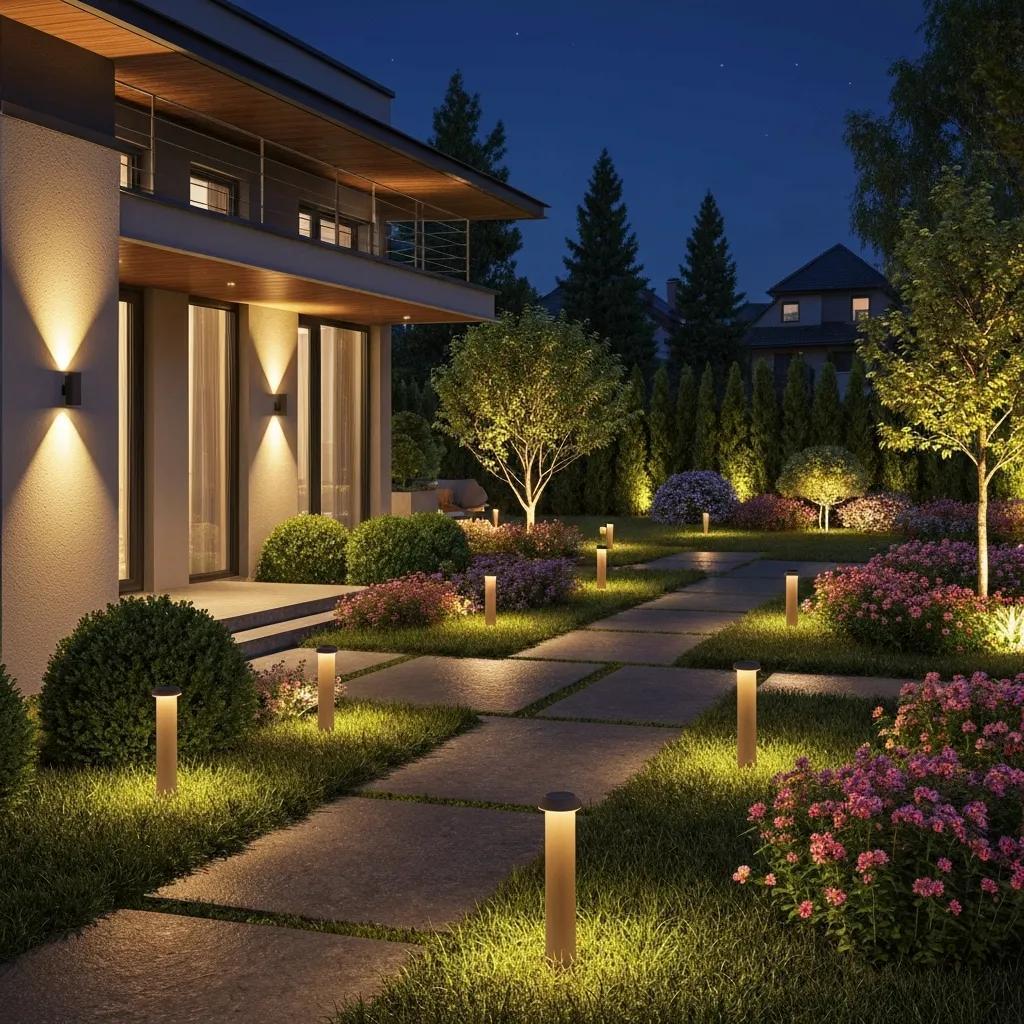
Good landscape lighting does more than just illuminate your yard—it turns your home into a safer, more inviting, and visually stunning space after dark. Well-placed fixtures highlight architecture, guide pathways, and bring gardens and patios to life, while energy-efficient LEDs and smart controls keep costs low.
This guide shows homeowners how to maximize visual impact, boost curb appeal, enhance safety, and extend outdoor living time with practical design tips, fixture recommendations, and maintenance advice. By the end, you’ll know exactly how to choose, place, and control outdoor lighting to make your home look its best while staying functional and efficient.
What Are the Key Benefits of Landscape Lighting for Residential Properties?
Landscape lighting does more than brighten your yard. It transforms your home after dark, highlighting architectural features, guiding visitors safely, and creating an inviting atmosphere for outdoor living. Thoughtful illumination also enhances security by reducing dark hiding spots, and modern LED or low-voltage systems lower energy use and maintenance, saving money over time. Below is a concise look at the main advantages homeowners experience:
Primary Benefits of Landscape Lighting
- Aesthetic Enhancement: Showcases façades, gardens, and pathways to boost curb appeal.
- Safety Improvement: Illuminates steps, walkways, and hazards to prevent accidents.
- Security Deterrence: Reduces concealed areas and supports surveillance.
| Benefit | Typical Effect | How It Helps |
|---|---|---|
| Curb appeal | Improved night aesthetics | Attracts buyers and enhances first impressions |
| Safety | Reduced trip hazards | Guides foot traffic and prevents falls |
| Security | Fewer concealment areas | Deters intruders and aids camera sightlines |
How Does Landscape Lighting Boost Curb Appeal and Property Value?
Landscape lighting transforms a property’s nighttime appearance, turning ordinary façades, pathways, and gardens into striking visual statements. Well-placed lights highlight architectural features, entryways, and landscaping layers, creating depth and warmth that draw attention and make the home feel inviting. This careful illumination signals care and quality to potential buyers, strengthening first impressions and often supporting higher perceived value. Energy-efficient fixtures add practical benefits, lowering operating costs while enhancing overall appeal. In short, effective lighting not only beautifies a property but also protects its investment by making it memorable and market-ready at night.
Building from the Outside In: Landscaping, Curb Appeal, and Exterior Design
Curb appeal is not defined by just a building‘s exterior aesthetic, but by one‘s first impression of the property. Building from the outside in: landscaping, curb appeal and exterior design.
Building from the outside in: landscaping, curb appeal and exterior design., 2011
In What Ways Does Outdoor Lighting Improve Home Safety and Security?

Outdoor lighting improves safety by increasing visibility on pathways, steps, and thresholds where most nighttime accidents occur, and it enhances security by removing dark hiding spots near entrances and along property edges. Placement best practices, such as low-level path lights, step lighting, and targeted spot lighting on entryways, create a graduated contrast that guides movement without causing glare. Motion sensors and timed schedules add active deterrence by surprising intruders and drawing attention to activity, while integration with cameras improves evidence capture. These layered approaches reduce risk and create a safer environment for family and guests.
How Can Landscape Lighting Extend and Enhance Outdoor Living Spaces?
Well-designed landscape lighting converts patios, decks, and pool areas into comfortable, functional evening environments by balancing ambient, task, and accent illumination. Ambient lights set the overall mood while task fixtures provide focused visibility for cooking, dining, or game areas, and accent lights add depth and interest to focal points like planters or water features. Color temperature choices and dimming controls influence perceived warmth and intimacy, helping shift from bright utility lighting to soft entertaining scenes. Below are fixture recommendations and placement guidelines that help homeowners plan layered lighting for social and relaxation spaces.
Recommended lighting solutions for patios, decks, and pools focus on safety, functionality, and ambiance. Consider these fixture types and uses:
- Recessed deck lights for step and perimeter safety.
- Pendant or string lights for overhead ambiance and gathering areas.
- Underwater-rated pool lights for safe water visibility and reflection.
These options combine to produce a flexible lighting plan that supports both everyday use and special events. Selecting fixtures with appropriate ingress protection (IP) ratings and using low-voltage or LED sources reduces maintenance and electrical risks near water.
What Are the Best Lighting Solutions for Patios, Decks, and Pool Areas?
Patios and decks benefit from a layered mix: warm ambient overhead or string lighting for mood, brighter task lights for cooking or reading, and low-profile step/rail lights for safety. Pool areas require fixtures rated for wet locations; underwater fixtures should meet local safety codes and be installed with appropriate transformers and GFCI protection. For entertaining, choose dimmable LEDs to tune scenes and prioritize fixtures with good color rendering (CRI 80+) to keep skin tones and surfaces natural at night. Combining these elements produces functional, safe, and inviting outdoor living zones.
How Does Ambient Lighting Create Inviting Outdoor Atmospheres?
Ambient lighting establishes the overall character of an outdoor space by setting a base luminance and color temperature that other layers complement. Warm white LEDs (around 2700–3000K) typically feel most inviting for residential patios, while slightly cooler tones can emphasize modern architecture. Scene-setting through dimmers and smart presets allows homeowners to shift atmospheres from relaxed evenings to active gatherings with a single control. Thoughtful ambient design minimizes harsh contrasts and avoids glare, enabling comfortable conversations and prolonged enjoyment of outdoor spaces.
The impact of ambient lighting on how safe people feel in outdoor environments is a significant factor in their willingness to use and enjoy these spaces.
Ambient Lighting and Perceptions of Public Safety in Outdoor Spaces
Good ambient lighting not only improves appearance but also makes people feel safer. Studies show that well-lit streets and public areas increase confidence and encourage nighttime activity. In one survey, more than half of participants were willing to pay extra for brighter, energy-efficient LED street lighting because it enhanced their sense of security. By providing even, glare-free illumination, homeowners and communities can improve both safety and comfort after dark.
Ambient lighting, use of outdoor spaces and perceptions of public safety: evidence from a survey experiment, J Kaplan, 2021
What Role Do Energy Efficiency and Smart Technology Play in Landscape Lighting?
Energy efficiency and smart controls significantly lower running costs and increase the flexibility of landscape lighting systems. LED fixtures consume far less power and last many times longer than incandescent or halogen sources, and smart scheduling or geofencing prevents unnecessary runtime, delivering measurable savings. Integration with home automation, offered by Light Disty, allows remote control, scene-setting, and adaptive schedules tied to sunset, conserving energy and enhancing convenience. The table below compares common energy sources and technologies to help homeowners evaluate trade-offs for performance and operating cost.
| Technology | Attribute | Value |
|---|---|---|
| LED | Energy Usage | High efficiency; substantially lower than halogen |
| Solar | Pros/Cons | No grid power required; performance varies by location |
| Low-voltage | Safety/Longevity | Easier installation and safer to handle during maintenance |
Comparing these technologies helps clarify which combination will deliver the best balance of initial cost, energy savings, and reliability for a given property. With that context, the next sections explain why LEDs are preferred and how smart controls optimize operation.
Why Is LED Technology the Preferred Choice for Outdoor Lighting?
LED technology is preferred because it achieves high luminous efficacy, delivering more light per watt, while offering superior longevity and color control compared with traditional lamps. LEDs commonly last tens of thousands of hours, reducing replacement frequency and ongoing maintenance, and their directional output suits focused accent techniques like uplighting. Choosing LEDs with appropriate CRI and color temperature preserves natural hues in gardens and façades, enhancing aesthetic outcomes. Because LEDs reduce power draw, pairing them with timers or smart schedules yields immediate operational savings.
How Can Smart Home Integration Optimize Landscape Lighting Control?
Smart home integration brings centralized scheduling, remote control, and scene automation that reduce runtime and boost convenience. Common workflows include sunset-based automation, geofencing to activate lights when occupants arrive, and grouped scene presets for entertaining versus security modes. Protocols vary, but the practical result is less wasted energy and more tailored experiences; for example, a homeowner can preset a “guest” scene that brightens pathways and softens accent lights on a single command. These automated behaviors both protect fixtures from unnecessary wear and make evening use effortless.
Which Landscape Lighting Techniques Best Highlight Garden and Architectural Features?

The right lighting can transform a garden or façade after dark, turning ordinary plants and structures into dramatic focal points. Uplighting brings trees and façades to life by casting light from the ground upward, adding height and impact. Grazing highlights textures on walls or surfaces with narrow-beam lights placed close to the structure. Silhouetting and backlighting create striking outlines and depth by illuminating subjects from behind, producing a layered, three-dimensional effect.
To make these techniques work, beam angles, spacing, and brightness need careful planning. Narrow beams suit tree trunks or small details, while wider beams cover broad façades. Dimming helps avoid glare and keeps lighting balanced, protecting neighbors’ sightlines. Combining techniques, like uplighting for vertical elements and grazing for texture, produces a polished, dynamic look that reads beautifully both up close and from a distance. Thoughtful application prevents overlighting and preserves the natural character of your outdoor space.
How Does Uplighting Accentuate Architectural Details and Trees?
Uplighting accentuates vertical elements by placing focused fixtures at the base of trees or on the ground aimed upward to reveal form and branch structure. Choosing a beam angle that matches the subject’s scale avoids spill light and minimizes glare; narrow beams concentrate on trunks while wider beams suit broad façades. Proper spacing and brightness balance create drama without flattening shadow detail, and combining uplighting with softer fill light preserves dimensional perception. When used judiciously, uplighting transforms night appearances by emphasizing silhouette, texture, and architectural rhythm.
What Are Effective Methods for Illuminating Water Features and Flower Beds?
Water features and flower beds respond well to low-profile accent lights that emphasize reflections, color, and texture without disturbing aquatic life or plant growth. Underwater-rated fixtures must meet wet-location standards and be installed with safe low-voltage transformers and circuit protection. For flower beds, low-angle accent lights highlight form and color while avoiding direct light into neighbors' windows. Selecting the right color temperature and minimizing runtime with timers enhances plant-friendly illumination and showcases seasonal blooms effectively.
How Do Different Types of Landscape Lighting Fixtures Enhance Safety and Security?
Different fixture types serve distinct safety and security roles by shaping how people and potential intruders perceive and navigate a property. Path lights provide continuous low-level illumination to guide foot traffic and prevent trips, spot and flood lights deliver targeted brightness for known access points, and motion-sensor lights offer responsive activation that alerts occupants and draws attention to movement. A layered scheme combining constant ambient path lighting with motion-activated security fixtures offers both comfortable navigation and effective deterrence. The comparison table below helps match fixture types to their typical lumen ranges and placement roles.
| Fixture Type | Typical Placement | Primary Safety/Security Role |
|---|---|---|
| Path Light | Along walkways | Guides pedestrians; prevents trips |
| Motion Sensor Light | Entrances/perimeter | Alerts to movement; deters intruders |
| Floodlight/Spotlight | Driveways, access points | Illuminates larger areas for visibility |
Use this matrix to prioritize fixtures based on the specific vulnerabilities and traffic patterns of your property. With fixture roles clarified, homeowners can design effective layered security plans that minimize blind spots.
What Are the Advantages of Path Lights and Motion-Sensor Security Lights?
Path lights offer steady, low-level illumination that guides movement and reduces the risk of falls, while motion-sensor lights conserve energy by activating only when needed and provide an attention-grabbing response to activity. Path lights should be spaced to create overlapping pools of light without creating glare; lower lumen outputs suffice for comfortable navigation. Motion-sensor lights should be aimed to cover approach routes and access points while avoiding false triggers from trees or street traffic. Combining both types yields continuous safety and reactive security without excessive energy use.
How Does Perimeter Illumination Deter Intruders and Prevent Accidents?
Perimeter illumination increases the perceived risk of detection for potential intruders by eliminating dark hiding spots and improving camera sightlines, and it enhances accident prevention by revealing obstacles along property edges. Principles of uniformity, avoiding deep dark gaps, help maintain consistent visibility, while targeted higher-lumen fixtures on gates and entry points create clear visual cues. It is important to balance intensity to prevent glare into neighboring properties and to coordinate lighting with surveillance systems for optimal coverage. Thoughtful perimeter design reduces both security risks and nighttime accidents.
What Are the Practical Considerations for Installing and Maintaining Landscape Lighting?
Practical considerations for landscape lighting include choosing between low-voltage and line-voltage systems, selecting appropriate transformers and timers, following safety compliance for wet locations, and planning maintenance routines to preserve performance. Low-voltage systems offer easier installation and increased safety for DIY-friendly projects, while line-voltage solutions may be necessary for high-output needs; transformers and correct wiring are essential for consistent performance. Regular inspections, cleaning fixtures, and checking connections reduce failures, and automated controls like timers and photocells cut unnecessary runtime and simplify operation. Below is a concise checklist and guidance for installation and upkeep.
Homeowner checklist for installation and maintenance provides practical, prioritized steps:
- Plan layout: Map fixtures, power sources, and wiring routes before installation.
- Choose voltage: Prefer low-voltage for safety and ease unless high output is required.
- Set controls: Use timers, photocells, or smart schedules to limit runtime.
This checklist helps homeowners prepare for installation decisions and ongoing care that extend system life and maintain aesthetic and safety benefits.
What Are the Benefits of Low-Voltage Systems and Timers in Outdoor Lighting?
Low-voltage systems (commonly 12V) reduce shock risk and allow for smaller-gauge cable runs and easier fixture placement, making them popular for residential landscape lighting. Transformers convert line voltage to a safe low-voltage output and permit centralized control with timers and dimmers, which in turn reduce energy consumption and component wear. Timers, photocells, or smart scheduling eliminate the need for manual operation and prevent lights from running during daylight, lowering operating costs. For most residential applications, low-voltage LED fixtures deliver the ideal combination of safety, efficiency, and design flexibility.
How Can Homeowners Ensure Energy Efficiency and Longevity of Their Lighting Systems?
Even with careful planning, landscape lighting often benefits from expert guidance. Lighting designers and certified installers can evaluate your property, recommend optimal fixture placement, and configure smart controls for maximum efficiency, safety, and visual impact. Professionals ensure compliance with local codes, prevent glare or uneven coverage, and help select fixtures that balance aesthetics with functionality. Engaging a qualified expert reduces maintenance issues, extends system longevity, and ensures your outdoor lighting performs beautifully year after year.
Conclusion
Implementing landscape lighting offers homeowners a multitude of benefits, including enhanced aesthetics, improved safety, and increased property value. By strategically illuminating pathways and architectural features, you create a welcoming environment that deters intruders and extends outdoor enjoyment. Understanding the various lighting techniques and energy-efficient options empowers you to make informed decisions for your home. Discover Light Disty’s range of landscape lighting solutions today to transform your outdoor spaces into stunning, functional areas.