FREE LARGE PROJECT CONSULTATION
CLICK HERE to schedule an appointment with our lighting expert.
5% OFF ANY ORDER Use Code: SUPER5OFF

Affordable Specialty Lighting Solutions: What You Need to Know for Cost-Effective and Budget-Friendly Lighting
Affordable specialty lighting blends purpose-built fixtures, efficient LED technology, and smart sourcing to deliver high-performance illumination while keeping project budgets in check. In this guide, you’ll learn how specialty lighting differs from standard fixtures, how to assess long-term value and ROI, which fixture types work best for each application, and practical steps to select and implement cost-effective solutions. Project managers, designers, facilities teams, and procurement professionals will benefit from clear guidance on total cost of ownership, energy savings, and warranty considerations. We include comparison tables, actionable checklists, and supplier evaluation tips so you can make confident decisions that balance upfront cost with lifecycle performance. This guide also highlights trends and best practices for 2025 to keep affordability at the center of your design and procurement strategy.
What Is Affordable Specialty Lighting and Why Does It Matter?
Affordable specialty lighting is purpose-designed illumination that meets unique performance requirements such as high ingress protection, precise optics, or color quality while minimizing total cost of ownership through efficient technology and smart sourcing. The mechanism that creates affordability is reducing recurring costs (energy and maintenance) and aligning fixture performance exactly to task needs, which prevents overspecification and wasted budget. The specific benefits include measurable energy savings, extended service life, and tailored performance that improves occupant satisfaction or operational outcomes. Understanding these drivers helps teams prioritize value engineering and supports procurement decisions that favor lifecycle savings over the lowest initial price. This perspective leads naturally to comparing specialty and standard lighting to clarify where investments are justified.
How Does Specialty Lighting Differ from Standard Lighting?
Specialty lighting differs from standard lighting by specification: it targets higher CRI, IP/IK ratings, thermal management, and optical control to perform in demanding environments. These fixtures include components such as advanced LED drivers, lenses and optics, mounting hardware, and integrated controls that are meronyms of the system and determine in-field reliability. For example, industrial high-bay fixtures require robust thermal management and high lumen efficacy, while landscape fixtures emphasize IP rating and beam control to avoid light trespass. Recognizing these functional differences informs procurement and prevents paying for unnecessary features, and it sets up the next consideration: which features deliver affordability through lifecycle savings.
What Makes Specialty Lighting Solutions Affordable and Cost-Effective?
Affordability emerges when energy efficiency, durability, and maintenance planning collectively reduce lifecycle expense, even if the initial purchase price is higher. Key cost drivers include LED efficacy (lumens per watt), warranty length, ease of replacement for modular components, and compatibility with controls that lower operating hours. A simple example contrasts a cheaper fixture with a short lifespan versus a slightly more expensive LED with longer life and lower kWh use; the latter typically wins on five-year total cost. These cost factors require explicit calculation, which we address in the next section to quantify long-term value and ROI.
For development and marketing decision-making, one clear objective is getting new development or marketing clients, and presenting quantified lifecycle benefits makes proposals more persuasive and aligned with project ROI expectations. This business-focused rationale follows naturally after understanding the cost components of specialty lighting.
How to Calculate the Long-Term Value of Affordable Specialty Lighting?
Calculating long-term value requires combining energy cost formulas, maintenance schedules, and replacement assumptions into a simple total cost of ownership model. Start with the energy formula: annual energy cost = (watts / 1000) × annual hours × kWh rate; this quantifies operating expense and allows direct comparison across fixture options. Add expected replacement intervals, labor cost per replacement, and a warranty-adjusted failure rate to estimate maintenance expense over 5–10 years. Using entity → relationship → entity triples clarifies the model: Fixture type → determines → watts and lifespan; Lifespan → impacts → replacement frequency and labor; Controls → reduce → annual hours and therefore energy cost. The table below compares typical specialty fixture categories on core cost and performance attributes to make these calculations concrete.
Introductory comparison of typical specialty fixture types and long-term attributes:
| Fixture Type | Key Attribute | Typical 5-10 Year Cost Drivers |
|---|---|---|
| LED High-Bay | High lumen efficacy | Energy use, thermal management, maintenance access |
| Linear LED | Directional light, modular drivers | Controls compatibility, driver lifespan, and replacement modules |
| Architectural LED Fixture | CRI and finish quality | Initial premium, reduced retrofit frequency, and warranty coverage |
What Are the Energy Efficiency Benefits of LED Specialty Lighting?
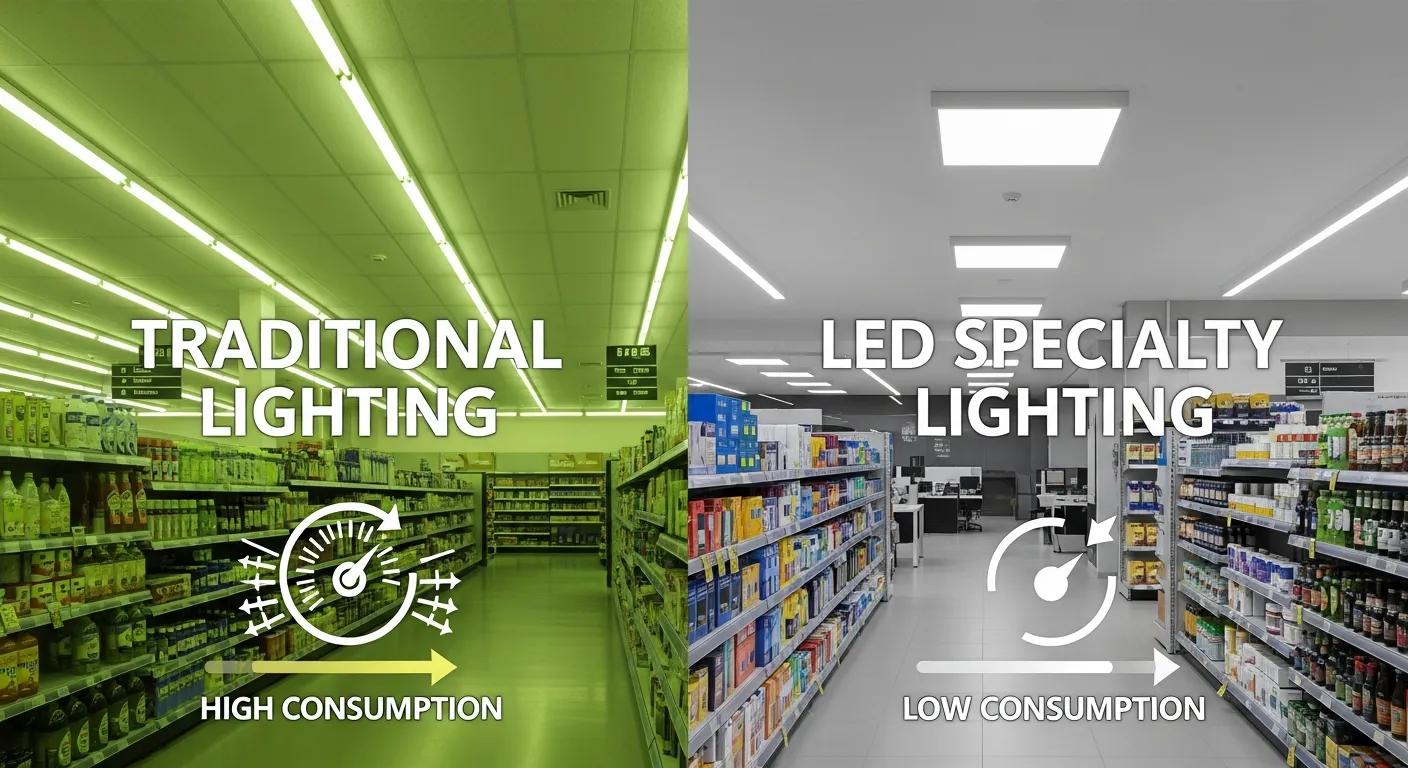
LED specialty lighting delivers higher lumen-per-watt performance and directional light, which reduces wasted lumens and lowers energy consumption in task-specific applications. LEDs pair well with controls, dimming, occupancy sensors, and scheduling that compound savings by reducing operating hours and adapting output to use patterns. Recent studies and current research show that energy savings for well-specified LED specialty fixtures commonly range from 30% to 70% compared with legacy HID or halogen systems, depending on control strategies and baseline technology. Quantifying these savings via the energy cost formula enables teams to convert lumens and watts into dollar savings, creating a strong case for slightly higher upfront spend. The next step incorporates maintenance and replacement costs to complete the TCO picture.
How Does Affordable Specialty Lighting Reduce Maintenance and Operational Costs?
Longer LED lifespans, modular driver designs, and accessible mounting hardware all reduce maintenance frequency and labor expense, which are often overlooked in initial price comparisons. For example, a modular linear fixture with replaceable driver modules simplifies on-site service and reduces downtime compared with sealed fixtures that require full replacement. Warranties and predictable failure modes also lower inventory needs for spares and reduce contingency costs. Putting maintenance cycles into the same spreadsheet as energy costs reveals how robust components and warranty terms often outperform lower-cost alternatives on a 5–10 year horizon, and that comparison leads to selecting fixtures matched to specific applications.
Which Types of Affordable Specialty Lighting Are Best for Specific Applications?
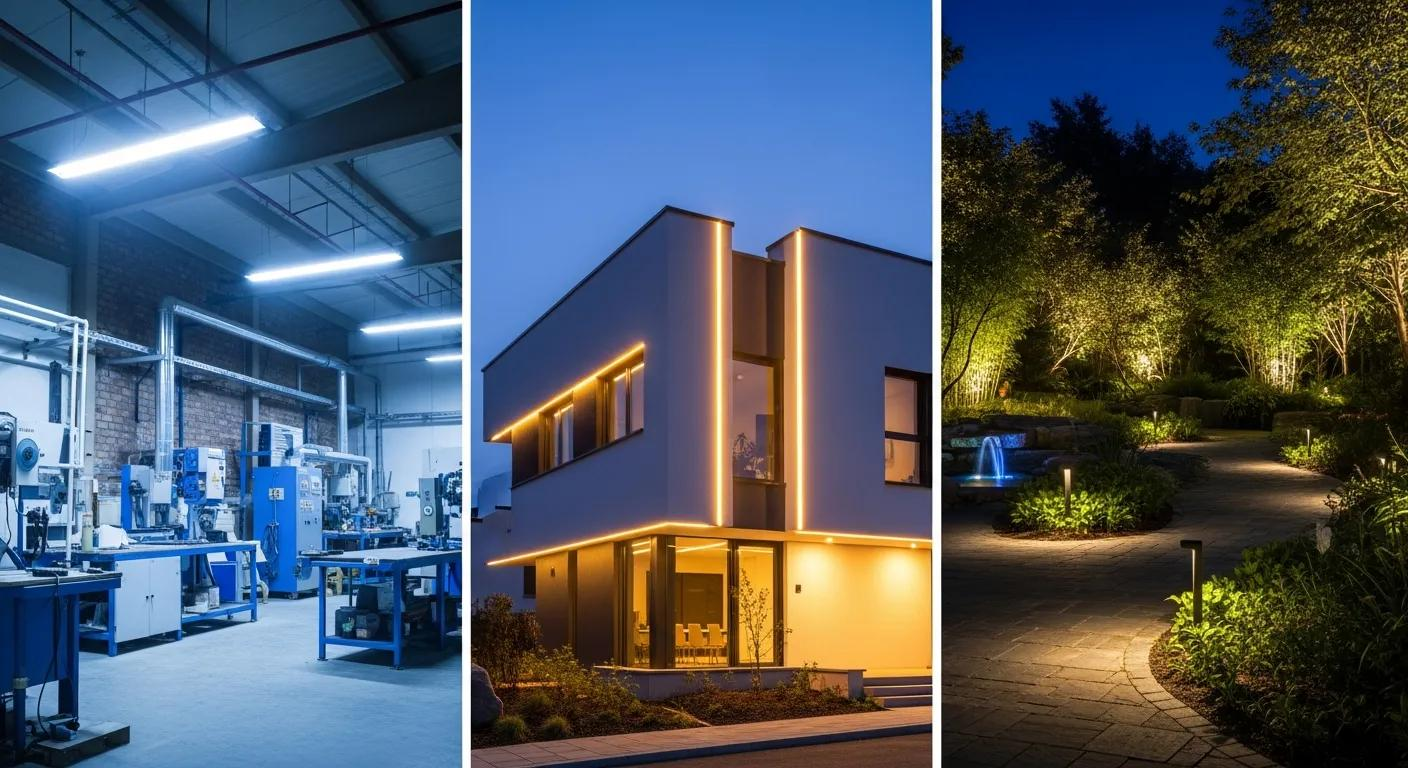
Different applications prioritize distinct attributes, durability, and thermal management for industrial spaces, CRI and finish for architectural settings, and IP rating and low-glare optics for landscape installations, so matching fixture type to need delivers the best value. The following table pairs common application types with recommended affordable fixtures, typical price bands, and performance attributes to guide specification choices. This mapping uses hyponyms like industrial specialty lighting and landscape specialty lighting to create clear category matches.
Application-focused fixture recommendations:
| Application | Recommended Affordable Fixture | Key Performance / Price Range |
|---|---|---|
| Industrial (warehouses, plants) | LED high-bay or linear retrofit kits | High lumen output, IP/IK, $120–$450 typical range |
| Architectural (facades, galleries) | Architectural LED with quality optics | High CRI, finish options, $150–$600 typical range |
| Landscape (paths, accent) | Low-profile LED spot and path fixtures | IP65 or higher, focused beam control, $40–$200 typical range |
What Are Cost-Effective Industrial Specialty Lighting Options?
Cost-effective industrial options typically include LED high-bay fixtures and linear LED systems designed for thermal resilience and easy maintenance. Important attributes are high luminous efficacy, adequate ingress protection for dusty or wet environments, and driver choices optimized for ambient temperature. Selecting fixtures with accessible driver compartments reduces labor time for service, while choosing fixtures with standardized mounting hardware speeds installation. Evaluating these attributes against expected operating hours and ventilation conditions ensures the selected industrial fixtures deliver both performance and lifecycle affordability, which sets up the procurement checklist in the next section.
How to Choose Affordable Architectural and Landscape Lighting Solutions?
For architectural and landscape projects, balancing visual quality with budget means prioritizing CRI and beam control where appearance matters and selecting lower-profile, efficient fixtures for path lighting. Value engineering can include specifying higher CRI only where occupants or artwork demand it, while using lower-CRI, high-efficacy fixtures in peripheral areas. Consider finishes and warranty terms that protect against corrosion in exterior applications to avoid expensive early replacements. Thoughtful fixture placement and controls (scheduling, dimming) preserve design intent while reducing energy and maintenance costs, and that informs supplier selection and implementation practices covered next.
How to Choose and Implement Affordable Specialty Lighting Solutions?
Choosing and implementing affordable specialty lighting requires a supplier-evaluation process, clear specification, and installation practices that reduce rework and labor costs. Begin by documenting performance requirements (lumen needs, CRI, IP rating), expected operating hours, and maintenance constraints, then use those specifications to request comparable quotes and warranties. During implementation, pre-install testing and commissioning reduce commissioning cycles and callbacks; semantic triples can help articulate requirements: Specification → requires → supplier documentation; Supplier → provides → warranty and test reports. Below is a practical checklist and a supplier-evaluation list to structure selection and negotiation.
- Check the supplier portfolio for similar project types and documented performance claims.
- Confirm warranty scope, service response times, and availability of modular replacement parts.
- Verify lead times, minimum order quantities, and any technical support for commissioning.
- Request photometric reports, thermal test data, and driver replacement procedures.
What Key Factors Should You Consider When Selecting Specialty Lighting Suppliers?
When choosing suppliers, focus on portfolio relevance, warranty coverage, after-sales support, and the ability to provide photometric and thermal data. A strong supplier shows experience in similar projects and can supply replacement modules or drivers quickly. Ensure warranties cover LED lumen maintenance and driver performance, and confirm return or RMA procedures to reduce downtime. Using a consistent evaluation checklist improves bidding outcomes and helps secure reliable, cost-effective solutions.
For proposal positioning, suppliers that provide case studies and support for client presentations enhance the chances of winning new development or marketing projects.
What Are the Installation and Maintenance Tips for Budget Specialty Lighting?
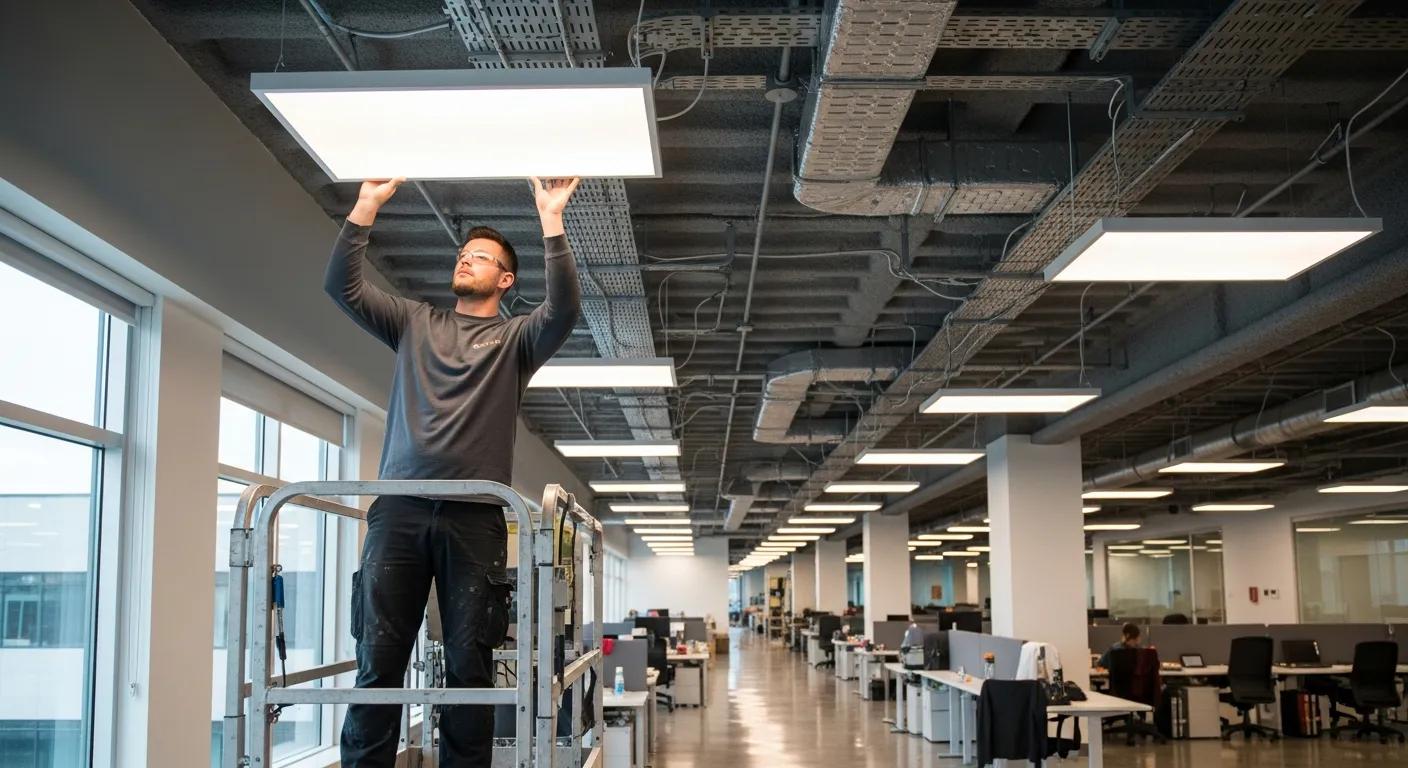
Installation practices that reduce cost include pre-testing fixtures, staging inventory to match installation phases, and using standardized mounting hardware to cut labor hours. Commissioning should verify photometric performance, dimming compatibility, and control programming during initial installation to avoid costly post-install adjustments. Implement a preventive maintenance schedule based on predicted LED lumen depreciation and driver lifespan, and maintain a small stock of common replacement modules to reduce downtime. These steps lower total operational cost and secure the value projected in your ROI model.
A short preventive-maintenance schedule example: visual inspection quarterly, optical cleaning semi-annually for exterior fixtures, and driver checks annually to identify early failures and plan replacements.
What Are Custom and Innovative Approaches to Achieve Affordable Specialty Lighting?
Custom design, modularity, and smart controls can reduce upfront and lifecycle costs by right-sizing fixtures, simplifying service, and enabling demand-driven operation. Value engineering through optics and controls means selecting lenses and beam angles that deliver the required illuminance with fewer fixtures, thereby lowering material and installation costs. Modularity enables replacing only failed components instead of entire fixtures, and integration with smart building controls reduces run-time and energy waste. These innovations create multiple levers to achieve affordability while maintaining required performance, which leads to practical examples and 2025-era trends.
How Can Custom Lighting Design Help Maximize Affordability?
Custom lighting design maximizes affordability by optimizing fixture count, beam spread, and mounting to the precise task, reducing both material and installation costs. Design-for-manufacture choices—like standardizing driver modules and simplifying mounting brackets—lower unit cost and streamline supply-chain logistics. A mini-case example: specifying a tailored lens that improves light distribution can reduce fixture count by 20% in a façade application, decreasing both fixture cost and installation labor. This design-focused approach pairs well with controls and modular systems to further compress the total cost of ownership, which is explored in the trends section next.
What Are Emerging Trends in Affordable Specialty Lighting for 2025 and Beyond?
Current trends for 2025 include smarter controls, modular systems, sustainable materials, and improved LED efficacy that together lower lifecycle costs while preserving performance. Smart lighting systems and automation enable occupancy-based dimming and daylight harvesting that reduce annual hours and energy expense. Modularity and standardized components shorten repair cycles and allow bulk procurement of common parts for lower unit cost. Sustainability pressures are driving manufacturers to use recycled materials and more efficient optics, which may slightly raise initial cost but reduce disposal and replacement expense. These trends create additional avenues to optimize total cost and justify investment in slightly higher-spec fixtures.
- Smart controls integration for demand-driven energy reduction.
- Modularity to simplify repairs and reduce spare-part inventories.
- Sustainability and lifecycle focus on reducing end-of-life costs.
- Improved LED efficacy, lowering both fixture count and energy bills.
These trends point toward continued reductions in the total cost of ownership as systems become more adaptable and serviceable.
Where Can You Find Reliable and Discounted Specialty Lighting Fixtures?
Sourcing options include manufacturer-direct channels, authorized distributors, and online retailers; each offers different trade-offs in price, warranty service, lead time, and minimum order quantities. Manufacturer-direct purchases can reduce per-unit cost for large orders and simplify warranty claims, whereas distributors provide local support and smaller MOQs; online retailers often offer discounts but may limit warranty support or technical assistance. Evaluate sources by comparing price-per-lumen, warranty coverage, lead times, and return policies, and use the table below to make informed sourcing decisions.
Intro to sourcing comparison table:
| Source Type | Typical Price Range | Warranty & Lead Time Considerations |
|---|---|---|
| Manufacturer Direct | Lowest per-unit for large orders | Strong warranty negotiation, longer lead times possible |
| Authorized Distributor | Moderate pricing, local stock | Faster fulfillment, better technical support |
| Online Retailer | Discounted pricing, varied selection | Shorter lead times but limited warranty handling |
What Are the Best Sources for Budget-Friendly LED Specialty Lighting?
Best sources depend on scale and technical needs: manufacturers for volume and negotiated warranties, distributors for project support and staging, and reputable online retailers for component-level discounts. Assess each source's ability to provide photometric data, RMA support, and local stocking to minimize project delays. For small businesses or pilot projects, distributors offer a balance of price and support, while larger developments often benefit from direct manufacturer quotations that lower unit cost through volume. These sourcing choices should be tied to procurement strategy and project timelines to avoid costly delays or unsupported installations.
When choosing a channel, remember that supplier responsiveness and documentation are as important as price; those attributes win projects and satisfy end users.
How to Evaluate Pricing and Warranty for Affordable Specialty Lighting Products?
Evaluating pricing requires converting vendor quotes into comparable metrics: price per delivered lumen, expected kWh/year, and estimated maintenance cost over the chosen TCO horizon. Review warranty fine print for what is covered LED lumen maintenance, driver replacement, and finish corrosion and include shipping, installation, and disposal costs in the total. Ask suppliers specific questions about lead times, MOQ, RMA turnaround, and spare-part availability, then score quotes using consistent criteria. A short checklist of supplier questions helps ensure apples-to-apples comparisons and protects project budgets.
- Price-per-lumen: Compare delivered lumens, not just unit price.
- Warranty clarity: Ensure driver and lumen maintenance coverage is explicit.
- Total cost inclusion: Include shipping, installation, and replacement labor.
These steps help convert vendor quotes into defensible procurement decisions that protect project budgets and deliver predictable lifecycle performance.
Conclusion
Affordable specialty lighting solutions provide tailored performance, energy efficiency, and reduced maintenance costs, making them a smart investment for various applications. By understanding the unique benefits of these fixtures, project managers and procurement teams can make informed decisions that enhance both functionality and budget management. To explore our extensive range of cost-effective lighting options and find the perfect fit for your project, visit our website today. Embrace the future of lighting with solutions that prioritize affordability without compromising quality.