FREE LARGE PROJECT CONSULTATION
CLICK HERE to schedule an appointment with our lighting expert.
5% OFF ANY ORDER Use Code: SUPER5OFF

Energy-Efficient Specialty Lighting Solutions for Your Business: How to Save Costs and Boost Efficiency
Looking to cut energy costs and boost efficiency in your commercial space? Energy-efficient specialty lighting combines high-performance LEDs, smart controls, and thoughtful design to save energy, reduce maintenance, and improve comfort. In this guide, we walk you through audits, retrofit strategies, and lighting controls, show how to access incentives, and explain ROI calculations. Whether you manage offices, warehouses, or retail spaces, you’ll discover practical steps to upgrade lighting, enhance productivity, and support sustainability, making your facility smarter, brighter, and more cost-effective.
What Are the Key Benefits of Energy-Efficient Lighting for Commercial Businesses?
Energy-efficient lighting helps commercial spaces cut energy use by replacing outdated fixtures with LEDs and applying smart controls to eliminate wasted runtime. By combining high-lumen-per-watt fixtures with scheduling, occupancy sensing, and daylight harvesting, businesses can achieve immediate reductions in kWh consumption and deferred replacement costs.
The measurable benefits include:
- Lower energy costs: Efficient fixtures and controls reduce monthly utility bills.
- Reduced maintenance: Longer-lasting LEDs cut replacement frequency and labor.
- Improved productivity and safety: Better lighting enhances task performance and minimizes errors or accidents.
- Sustainability and compliance: Reduced emissions support ESG goals and regulatory requirements.
In typical retrofits, these upgrades often deliver single- to low-double-digit reductions in total lighting energy use, setting the stage for practical savings through LED and smart control implementations.
How Does Energy-Efficient Lighting Reduce Business Energy Costs?
Energy-efficient fixtures reduce consumption largely through improved luminous efficacy and smarter operation, which together lower the facility’s kilowatt load and run-hours. Practically, replacing a 400 W metal-halide high-bay with a 120 W LED that delivers the same lux reduces power draw by 280 W per fixture; multiplied by hours of operation and the utility rate gives annual savings. For example, a 280 W reduction across 50 fixtures running 3,000 hours/year at $0.12/kWh yields savings of about $5,040/year in energy alone. Maintenance savings compound this: LEDs often last multiple times longer than legacy sources, cutting lamp and ballast replacement costs and associated labor. Understanding these mechanisms prepares facility teams to prioritize high-impact zones where both base load and hours are greatest, which we explore next.
In What Ways Does Improved Lighting Enhance Workplace Productivity and Sustainability?
Higher-quality light measured by CRI, appropriate CCT, and stable flicker performance improves visual acuity, reduces eye strain, and supports task accuracy, which in turn raises productivity and reduces errors. Human-centric lighting (HCL) further aligns spectral content and timing with circadian cues to support alertness during work periods and recovery during off hours, with emerging studies showing measurable effects on concentration and fatigue. From a sustainability perspective, lower energy use reduces greenhouse gas emissions and supports ESG disclosures that many stakeholders now expect. Quantifying both energy and human outcomes enables a business case that moves beyond utility savings to include productivity gains, which facilities managers can use when prioritizing projects across portfolios.
Which Types of Energy-Efficient Specialty Lighting Solutions Are Best for Your Business?
Selecting the right mix of fixtures and control architectures depends on application: high-bay LEDs for warehouses, tunable troffers for offices, accent LEDs for retail, and robust outdoor solar or LED options for site lighting. Systems combine LED fixtures, drivers, sensors, and network gateways so that each element contributes to kWh reduction, lifecycle cost reduction, and operational insight. The comparison table below helps decision-makers weigh typical energy use, lifespan, best applications, and estimated savings when choosing among LED fixtures, smart controls, sensors, high-efficiency fluorescent replacements, and solar outdoor lighting. After the table, we discuss how retrofit kits versus full fixture replacement and controls integration determine installation complexity and savings.
This table compares common energy-efficient specialty lighting options for commercial use.
| Lighting Type | Typical Energy Use | Typical Lifespan | Best Applications | Estimated Savings |
|---|---|---|---|---|
| LED fixture (integral) | 60–150 W for common commercial fixtures | 50,000–100,000 hours | Offices, retail, warehouses, high-bays | 40–70% vs. legacy sources |
| LED retrofit kit | 60–200 W equivalent | 30,000–70,000 hours | Retrofit scenarios where housing is reused | 30–60% |
| Smart lighting controls | Varies (adds <5 W) | 10+ years for controllers | All commercial spaces for scheduling and analytics | An additional 10–40% on controlled circuits |
| Occupancy & daylight sensors | 0.5–3 W per sensor | 5–15 years | Offices, corridors, loading zones | 10–50% in intermittent-use areas |
| Solar outdoor LED lighting | 5–50 W (solar managed) | 25,000–50,000 hours | Perimeter, parking, signage | Eliminates grid kWh for many sites |
What Are the Advantages and Applications of Commercial LED Lighting Solutions?
Commercial LED fixtures provide high lumen output per watt, predictable photometric distributions, and long operational lifetimes, which together reduce both energy consumption and lifecycle cost. Typical lumens-per-watt for commercial LEDs commonly fall in ranges that outperform fluorescent and HID equivalents, enabling either reduced wattage for the same illuminance or increased light levels for better task performance. Popular fixture families include troffers and linear fixtures for offices, high-bay for warehouses, and accent fixtures for retail merchandising; each offers specific optical choices to tailor glare, uniformity, and color rendering. The controlled driver electronics also support dimming and networked controls, which extend savings and add operational features such as scheduled dimming and remote diagnostics.
How Do Smart Lighting Systems and Controls Optimize Energy Use in Businesses?
Smart lighting systems use occupancy sensors, daylight harvesting, scheduling, and centralized management to ensure light is available only where and when needed, which multiplies fixture-level savings across a facility. Control architectures range from standalone sensors that switch or dim local circuits to networked IoT platforms that enable zoning, analytics, and integration with building management systems (BMS). The additional savings potential stems from reduced idle-on time, targeted dimming, and adaptive profiles that respond to daylight and occupancy patterns, often delivering a further 10–40% in energy reduction beyond fixture swaps. Integration with BMS also allows for fault detection and predictive maintenance, reducing downtime and unplanned labor.
These control strategies and fixture choices set the stage for quantifying savings and capturing incentives, which we address next.
How Can Businesses Maximize Savings Through Energy-Efficient Lighting Upgrades?
Maximizing savings starts with a clear financial approach: identify available utility rebates and tax incentives, calculate payback and lifecycle costs, and consider financing or Lighting-as-a-Service options that fit cash flow. Begin with a conservative ROI model including initial capital costs, projected energy savings (kWh), expected maintenance reductions, and applicable incentives. After calculating simple payback and net present value (NPV), explore financing options that preserve capital while delivering immediate operational savings.
The table below summarizes common incentive types, typical coverage, and how to apply:
| Incentive Type | Who It's For | Typical Coverage | How to Apply |
|---|---|---|---|
| Utility rebates | Commercial accounts (customers) | 10–70% of incremental cost or $/fixture | Submit pre-approval application with project scope and post-install documentation |
| Tax credits & deductions | Owners and lessees (varies) | Dependent on jurisdiction and program | Work with a tax advisor and retain invoices and technical specs |
| Performance contracting / ESCO financing | Large portfolios and public entities | Covers up-front cost repaid from guaranteed savings | Engage ESCO for audit, guarantee, and measurement plan |
| On-bill financing & LMI programs | Small businesses and municipalities | Loan terms tied to utility bills | Apply via the utility program with underwriting |
After incentives, calculate ROI with this formula:
- Annual Savings = kWh Reduction × Utility Rate
- Payback = Net Project Cost / Annual Savings
- NPV = discounted net cash flows over the asset lifetime
For example, a $100,000 project with $25,000/year in combined energy and maintenance savings and $20,000 in rebates yields a net cost of $80,000 and a simple payback of 3.2 years. NPV and sensitivity to energy price escalation can further guide portfolio decisions.
Many organizations benefit from professional project management to access incentives and optimize payback. A turnkey pathway—audit → design → install → verify—helps capture incentives efficiently and ensures verified savings through Measurement & Verification (M&V), improving net returns and project speed.
What Utility Rebates and Financial Incentives Are Available for Commercial Lighting Upgrades?
Utility rebates and incentives vary by region but commonly include prescriptive rebates (per-lamp or per-fixture), custom incentives based on measured savings, and incentives for controls or complete system upgrades. Documentation for rebate capture typically requires pre-approval, product specifications, installation photos, and post-install measured usage or simple engineering estimates. Businesses should expect coverage ranging from modest per-fixture payments to substantial percentages of incremental cost for large, custom projects; these programs frequently change, so engaging program administrators early is essential. A provider experienced in rebate capture can streamline application steps and ensure required paperwork and verification are completed to maximize incentive capture.
How Do You Calculate ROI and Long-Term Cost Savings from Lighting Upgrades?
A practical ROI workflow starts with baseline metering to determine existing kWh consumption, then applies fixture and control efficiency gains to estimate annual kWh reductions. Use Annual Energy Savings ($) = Baseline kWh × % Reduction × Utility Rate. Add maintenance savings to that figure and subtract any incentives to determine the net project cost. Payback = Net Cost / Annual Savings, and NPV = sum of discounted net cash flows over the asset lifetime. For example, with a projected 60,000 kWh annual reduction at $0.12/kWh = $7,200/year energy savings, plus $1,800/year maintenance savings, and a $15,000 rebate on a $100,000 project, net cost = $85,000 and payback ≈ 9.7 years; adjusting for higher energy prices or controls often shortens payback materially. Running sensitivity analyses on energy price and incentive scenarios helps prioritize projects with the strongest financial metrics.
Once ROI is clear, the implementation process translates plans into verified results, which we outline next with actionable steps and an EAV-style roadmap.
What Is the Process for Implementing Energy-Efficient Lighting Solutions in Commercial Spaces?
A standardized implementation lifecycle audit, design, installation, and verification ensures deliverables, roles, and timelines are clear and that projected savings are realized and documented. The audit identifies opportunities and establishes a baseline, design specifies fixtures and controls tuned to applications, installation executes physical work with quality checks, and verification uses M&V protocols to confirm savings against baseline expectations. Below is a scannable project-stage table that assigns deliverables and typical durations, followed by a numbered process list to guide execution. This roadmap helps stakeholders understand responsibilities and acceptance criteria before capital is committed.
| Project Stage | Deliverable | Typical Duration / Responsibility |
|---|---|---|
| Audit | Inventory, baseline metering, quick-win list | 1–3 weeks/energy auditor or provider |
| Design | Lighting layout, fixture specs, control strategy | 2–6 weeks/lighting designer/engineer |
| Installation | Physical replacement, controls commissioning | 1–8 weeks / electrical contractor |
| Verification (M&V) | Post-install metering, savings report | 1–4 months / M&V specialist or provider |
- Conduct a lighting audit to establish baseline energy use and quick wins.
- Develop a final design with fixture schedules, control topology, and cost estimates.
- Secure incentives and financing, obtain pre-approvals if required.
- Execute installation with commissioning and initial performance testing.
- Perform Measurement & Verification to confirm actual savings and close incentive paperwork.
These steps form a repeatable program for portfolio upgrades and support continuous improvement through analytics and periodic re-evaluation, which connects directly to sector-specific strategies discussed next.
How Does a Commercial Lighting Audit Identify Energy-Saving Opportunities?
A commercial lighting audit combines visual inventory, fixture-level counts, operating schedules, and spot metering to create a baseline and identify highest-impact upgrades. Auditors document fixture types, wattages, control schemes, and typical hours of operation, then prioritize areas where run-hours and power draw are greatest, usually warehouses, loading docks, and external lighting. Quick-win opportunities often include simple lamp and ballast replacements, adding vacancy/occupancy sensors, or implementing scheduling for overnight and weekend periods. The audit deliverable includes an estimated savings report, scope of work, and a recommended project plan that feeds directly into the design phase.
Identifying these quick wins makes the subsequent design and installation steps more efficient and cost-effective.
What Are the Steps for Design, Installation, and Verification of Lighting Upgrades?
Design begins with photometric layouts and fixture selection to meet target illuminance, uniformity, and CRI requirements while minimizing glare and over-lighting. Installation best practices include circuit tagging, control wiring separation, surge protection for drivers, and staged commissioning to verify dimming and sensor behavior. Verification relies on Measurement & Verification (M&V) protocols such as IPMVP-style approaches: Option A (retrofit-isolation) or Option C (whole-facility), depending on project scope, using pre- and post-metering to confirm kWh savings. Acceptance criteria should be documented in advance (lux targets, control setpoints, energy targets) so the project can be signed off and incentives finalized.
Clear design-to-verification steps reduce risk and ensure realized savings align with modeled expectations, enabling confident portfolio-level planning.
Which Specialty Lighting Applications Deliver the Best Results for Different Business Sectors?
Different sectors demand tailored fixture and control strategies: warehouses benefit most from high-bay LEDs with motion zones and daylighting at loading docks, offices gain from layered HCL task lighting and daylight harvesters, and retail sees both energy savings and sales lift from targeted accent lighting. Matching optical distribution, luminaire placement, and control zoning to the activity patterns of each sector ensures both energy and experience goals are met. Below are sector-specific recommendations and a concise list of best-practice strategies to apply when specifying projects for each business type.
How Are Industrial and Warehouse Lighting Solutions Tailored for Energy Efficiency?
Industrial and warehouse lighting uses high-bay LEDs with specific optical distributions to deliver uniform floor and shelf illumination while minimizing wasted uplight and glare. Zoning and motion-detection strategies that segment aisles and storage areas into independently controlled groups allow lights to remain off or dimmed in unoccupied zones, which is highly effective in spaces with intermittent occupancy. Daylight harvesting near dock doors and skylights further reduces grid consumption during daylight hours, and rugged fixtures with high ingress protection minimize maintenance and failure in harsh environments. Together, these approaches can deliver 50% or greater reductions in lighting energy for many facilities.
What Are Effective Energy-Efficient Lighting Strategies for Offices and Retail Spaces?
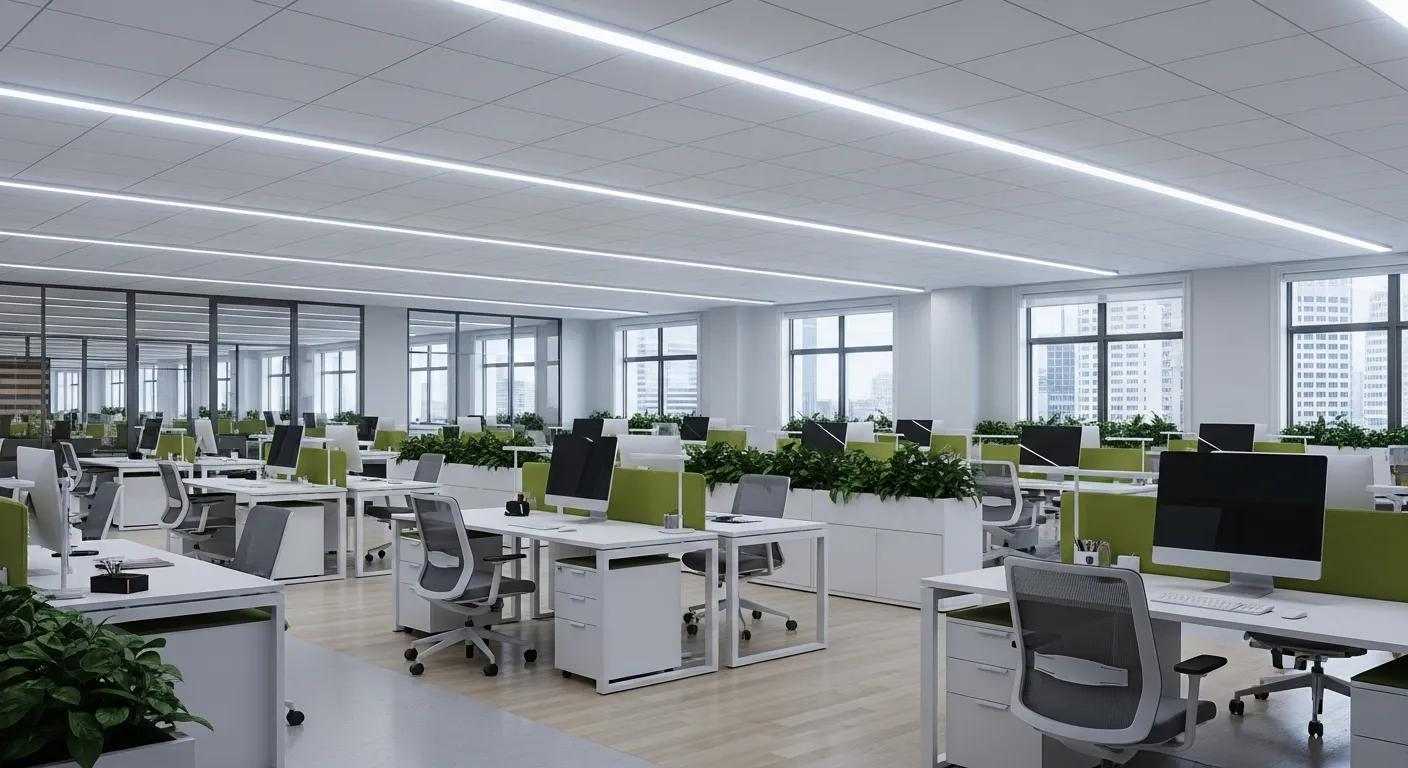
Offices benefit from tunable white fixtures and task lighting that align with HCL principles, reducing overall installed power while improving occupant comfort and productivity. Implementing daylight harvesting near windows and personalized dimming controls at workstations reduces unnecessary usage and empowers occupants. Retail spaces combine efficient ambient lighting with LED accent fixtures that concentrate light where it matters for merchandising, enabling lower ambient levels without sacrificing visual impact. Balancing energy goals with experience requires specifying CRI ≥80 and appropriate CCTs, plus controls that allow scenes for different operating hours and events.
What Are the Emerging Trends and Technologies in Energy-Efficient Specialty Lighting?
Emerging trends center on human-centric lighting, IoT-connected fixtures, analytics-driven maintenance, and sustainability tie-ins like embodied carbon assessment and circular product strategies. Human-centric lighting emphasizes tunable white spectra and schedules that support circadian rhythms, while connected lighting platforms deliver asset tracking, fault detection, and energy analytics that enable predictive maintenance and continuous optimization. Businesses should consider future-proof hardware choices (open protocols, secure gateways) to protect investments and facilitate integration with building management systems and enterprise analytics. Below is a concise list of leading trends and their business implications to guide pilot selection.
- Human-centric lighting and tunable white systems to support wellness and productivity.
- IoT-connected lighting that provides analytics, asset management, and fault detection.
- Advanced sensors (spectral, occupancy, environmental) enabling more nuanced controls.
- Sustainability-focused product selection with recyclability and lifecycle accounting.
How Is Human-Centric Lighting Enhancing Commercial Environments?
Human-centric lighting (HCL) adapts spectral output and intensity to support circadian alignment, which can improve alertness, mood, and sleep quality when deployed thoughtfully in workplaces. Pilot programs typically track metrics such as employee feedback, absenteeism, and performance indicators alongside energy data to quantify non-energy benefits. Implementation considerations include selecting tunable fixtures with adequate dimming range, integration with occupancy and schedule profiles, and measuring outcomes over months rather than days to capture circadian effects. For many organizations, HCL pilots start in shared spaces or conference areas where controlled studies can demonstrate benefits before broader rollouts.
What Role Do IoT and Smart Controls Play in Next-Generation Lighting Solutions?
IoT-enabled lighting systems turn fixtures into data sources, enabling energy analytics, real-time fault detection, remote commissioning, and asset tracking. Dashboards convert this data into actionable maintenance schedules and verify savings. Platforms with open standards, cybersecurity, and BMS compatibility ensure scalability and avoid vendor lock-in. Combined with human-centric lighting (HCL), IoT creates energy-efficient, occupant-friendly environments while supporting continuous commissioning and long-term savings.
Conclusion
Implementing next-generation lighting starts with a thorough audit or pilot program to quantify site-specific savings and verify ROI. At Light Disty, we guide businesses through every step from selecting the right IoT-enabled systems and human-centric lighting solutions to optimizing energy use and capturing incentives. Our expertise ensures measurable cost reductions, improved occupant comfort, and scalable solutions that support sustainability goals and long-term operational efficiency.