FREE LARGE PROJECT CONSULTATION
CLICK HERE to schedule an appointment with our lighting expert.
5% OFF ANY ORDER Use Code: SUPER5OFF

Outdoor Sports Lighting Options for Your Facility: Energy-Efficient LED Solutions and Design Strategies

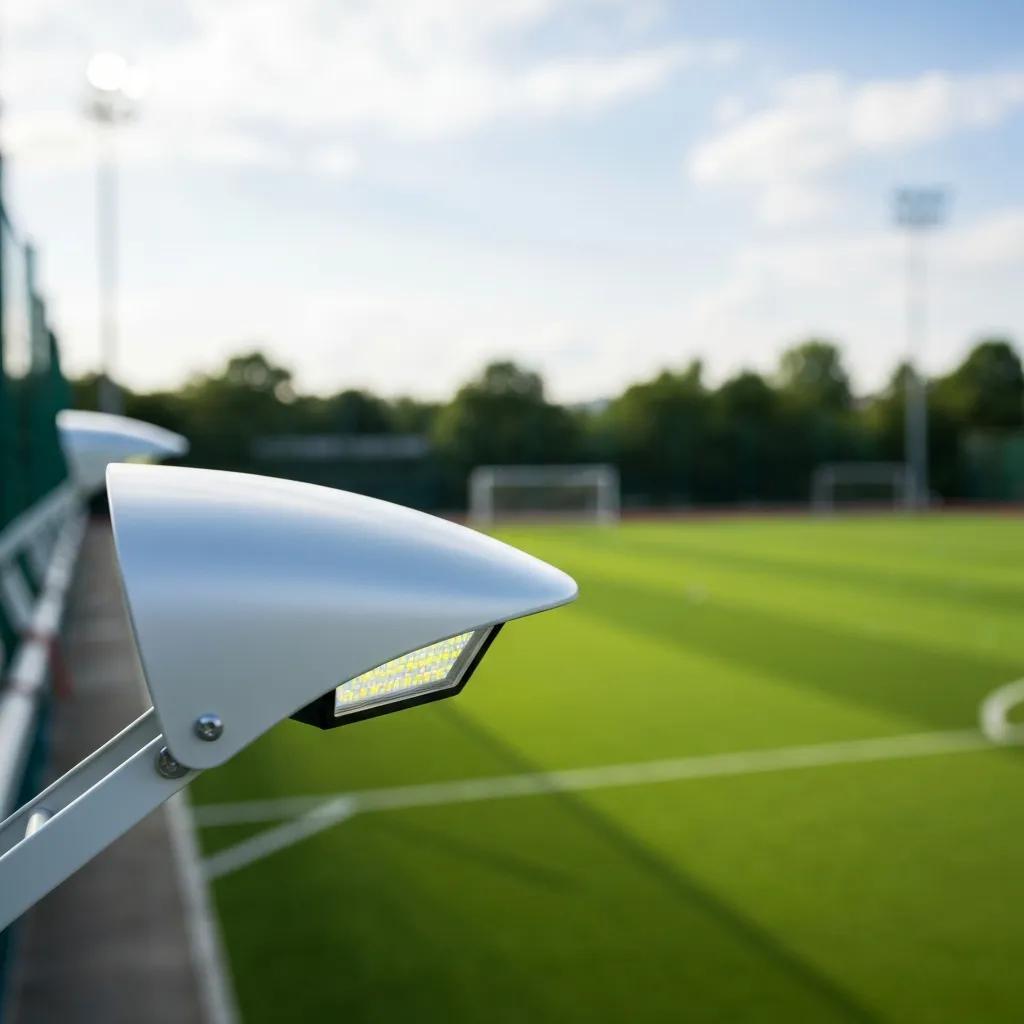
Outdoor sports lighting is a carefully engineered system of fixtures, poles, and controls that ensures optimal illumination, uniformity, and visual comfort for athletes, spectators, and broadcasts. LED lighting has become the standard, offering energy efficiency, longer lifespans, and advanced controls to solve issues like high energy costs, uneven light, and glare. This guide covers design strategies, sport-specific targets, cost and ROI considerations, funding options, and vendor selection, with practical tables and checklists to help you plan and commission your system confidently.
Why Is LED the Best Choice for Outdoor Sports Field Lighting?
LED lighting delivers high luminous efficacy, precise beam control, and long operational life, which together reduce energy use, minimize maintenance, and improve visual performance on the field. LEDs convert a larger portion of electrical energy into useful light, enabling lower kilowatt-hour consumption for the same lux level compared with metal halide or high-pressure sodium fixtures. The superior Color Rendering Index (CRI) and selectable color temperature of LEDs enhance player visibility and broadcast quality, while controls such as dimming and zoning enable further operational savings and event-based tuning. Below is a compact comparison to clarify typical differences between technologies and decision drivers for facility upgrades.
| Technology | Metric | Typical Value |
|---|---|---|
| LED floodlights | Energy use | 40–70% lower kWh vs. metal halide |
| Metal Halide | Lifespan | 5,000–15,000 hours |
| High-Pressure Sodium (HPS) | CRI | Lower (yellow-orange bias) |
This table highlights why LEDs often deliver the best long-term value for sports facilities, and it sets the stage for quantifying energy and maintenance savings in design and ROI calculations.
What Are the Energy Efficiency Benefits of LED Sports Lighting?

LED sports lighting reduces operational energy by delivering higher lumens per watt and by enabling targeted illumination that reduces wasted spill light. Typical facility upgrades to LED yield energy reductions in the 40–70% range compared with metal halide or HPS systems, depending on control strategies and baseline system efficiency. Smart dimming, scheduling, and occupancy zoning multiply those savings by lowering output during practice, non-game hours, and within unused zones. Understanding these savings is essential when modeling payback and defining specifications that support utility incentives and rebate eligibility.
These efficiency benefits naturally lead to questions about reliability and maintenance, which is the next critical area for facility planners to evaluate.
How Do LED Lifespan and Durability Impact Facility Maintenance?
LED fixtures commonly specify L70 or L80 metrics indicating the rated hours before lumen output drops to 70% or 80% of initial output, with typical ratings between 50,000 and 100,000 hours for quality sports fixtures. Higher IP ratings (IP65–IP66) and robust thermal management ensure reliable outdoor performance in wet or dusty conditions, reducing unscheduled relamping and bucket-truck maintenance. Reduced maintenance frequency lowers lifetime labor and transport costs and reduces disruptions to the field schedule, improving total cost of ownership compared to legacy technologies. Evaluating warranty terms and thermal design during procurement ensures long-term durability and predictable maintenance planning.
Reduced maintenance needs also free up budget and operations time that can be redirected to higher-priority facility work, which informs design and procurement decisions discussed next.
How Do You Design Optimal Sports Facility Lighting for Different Sports?

Sports lighting design defines the required illuminance (lux or footcandles), uniformity ratio, vertical illuminance for player visibility, and glare limits, all tailored to sport, competition class, and spectator or broadcast needs. The design process begins with the target lux and uniformity, then selects pole heights, aiming angles, fixture beam patterns, and counts to achieve the distribution while minimizing spill and glare. Simulation tools and standards-based methods (for example, IES-referenced procedures) are used to model beam overlap and uniformity, then refined on-site at commissioning to hit performance metrics. Below is a compact reference table showing recommended lux and uniformity by sport and class of play to guide preliminary design decisions.
| Sport / Class | Recommended Lux (Avg) | Target Uniformity (Avg:Min) |
|---|---|---|
| Football / Recreational | 75–150 lux | 0.4–0.6 |
| Football / Competitive | 200–500 lux | 0.6–0.8 |
| Tennis / Recreational | 200–300 lux | 0.6–0.8 |
Use these initial targets to define simulation parameters; next, we examine how pole height and aiming transform those targets into fixture counts and layouts.
What Are the Recommended Lux Levels and Uniformity Standards by Sport?
Recommended lux levels vary with competition level and broadcast needs: recreational play requires lower average illuminance than competitive or televised events, while uniformity ratios improve player safety and perceived quality. For court sports like tennis and pickleball, vertical illuminance is critical for ball tracking, so designers specify both horizontal and vertical lux values. Uniformity (average-to-minimum ratio) typically ranges from 0.4 for basic community fields to 0.8 for broadcast-quality stadiums. Standards from professional organizations and the IES provide class-by-class guidance that designers use to size and aim fixtures to meet both athlete and broadcast requirements. Applying these standards at the design stage reduces the risk of under-illumination or costly rework during commissioning.
LED systems in professional stadiums deliver energy efficiency, superior visual comfort, and meet 4K broadcast requirements. Studies show they are a mature, effective alternative to traditional lighting, significantly influencing overall stadium lightingquality (RD Orejón-Sánchez, 2020).
How Do Pole Height and Fixture Placement Affect Light Distribution?
Pole height strongly influences beam spread, overlap, and the number of fixtures required to hit lux/uniformity targets: taller poles increase coverage per fixture but require higher lumen output and careful aiming to control glare and spill. Typical pole heights differ by sport, lower for tennis courts (8–16 m) to optimize vertical illuminance, and higher for football/soccer fields (12–30 m) to achieve uniform coverage. Aiming angles, asymmetric optics, and tilts are used to shape distribution toward playing surfaces and away from spectator sightlines and nearby residences, reducing light pollution. Early coordination between civil design for pole foundations and lighting layout prevents costly field conflicts and ensures mechanical stability.
A rough set-based method for aiming angle tuning of luminaires for outdoor sports lighting
A rough set-based method for aiming angle tuning of luminaires for outdoor sports lighting installation. This modified design process takes the aiming angles of determinant luminaires as the input for the optimization of a total of six lighting parameters.
A rough set-based method for aiming angle tuning of luminaires for outdoor sports lighting, D Nath, 2016
What Are the Best Outdoor Stadium Lighting Solutions for Specific Sports?
- Selecting fixtures and optical systems depends on field geometry, vertical sightlines, broadcast camera angles, and the desired balance of energy efficiency and visual performance.
- Wide rectangular fields like football and soccer benefit from medium-to-narrow beam stadium optics, with high-mast or perimeter mounting to ensure even lateral coverage and minimize glare for players and spectators.
- Court sports such as tennis, pickleball, and basketball require optics that provide strong vertical illuminance to support player visibility and broadcast clarity, with lower pole heights to optimize vertical light distribution.
- Multi-sport venues should use modular fixtures with interchangeable beam modules and zoned controls to allow tuning for different sports without replacing hardware, supporting flexibility for current and future activities.
- Fixture selection must consider lumen packages, beam angles, and mounting options to match both current and anticipated use cases while balancing energy efficiency, visual quality, and cost-effectiveness, with guidance from Light Disty.
- Sport-specific fixture choices influence total fixture counts, aiming strategies, and installation costs, so evaluating these factors early reduces rework and ensures reliable lighting performance.
What Are Football and Soccer Field Lighting Requirements?
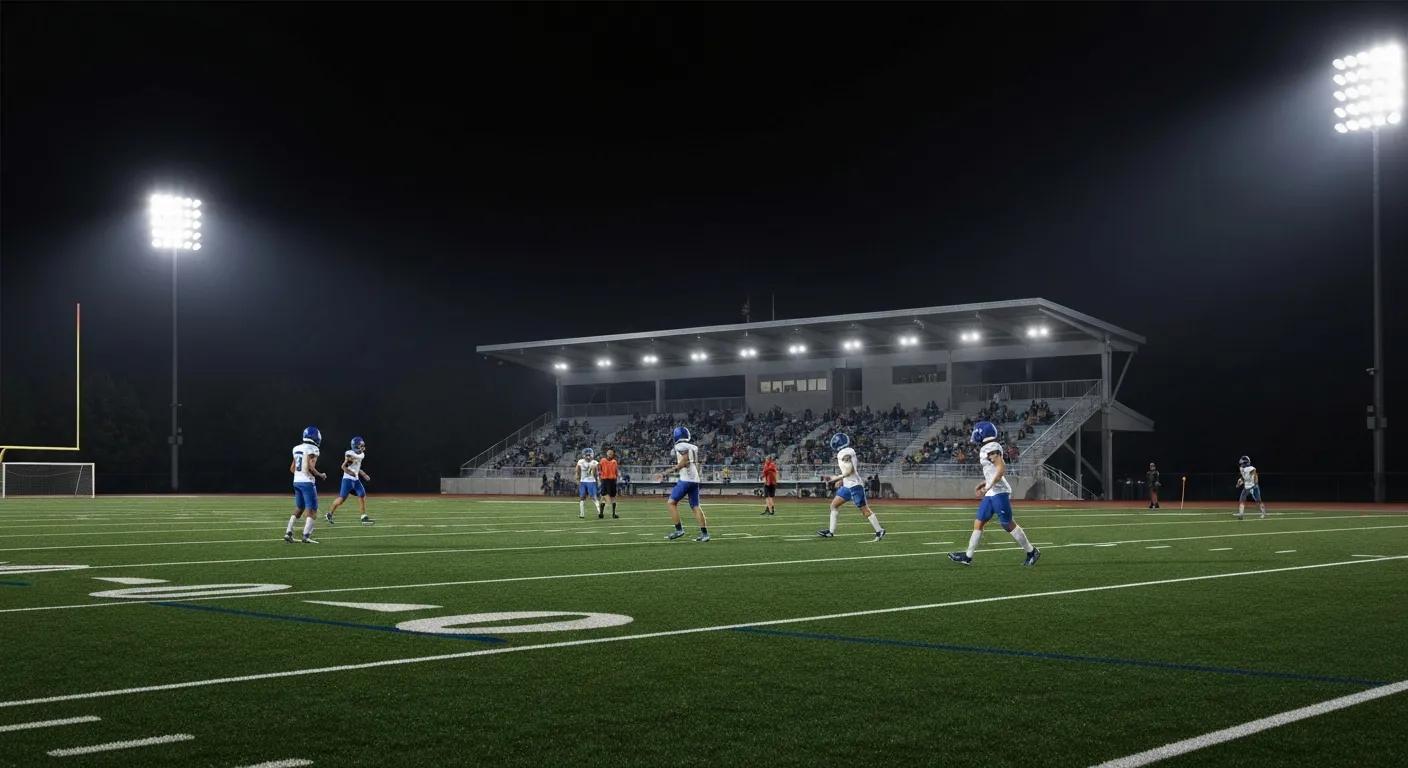
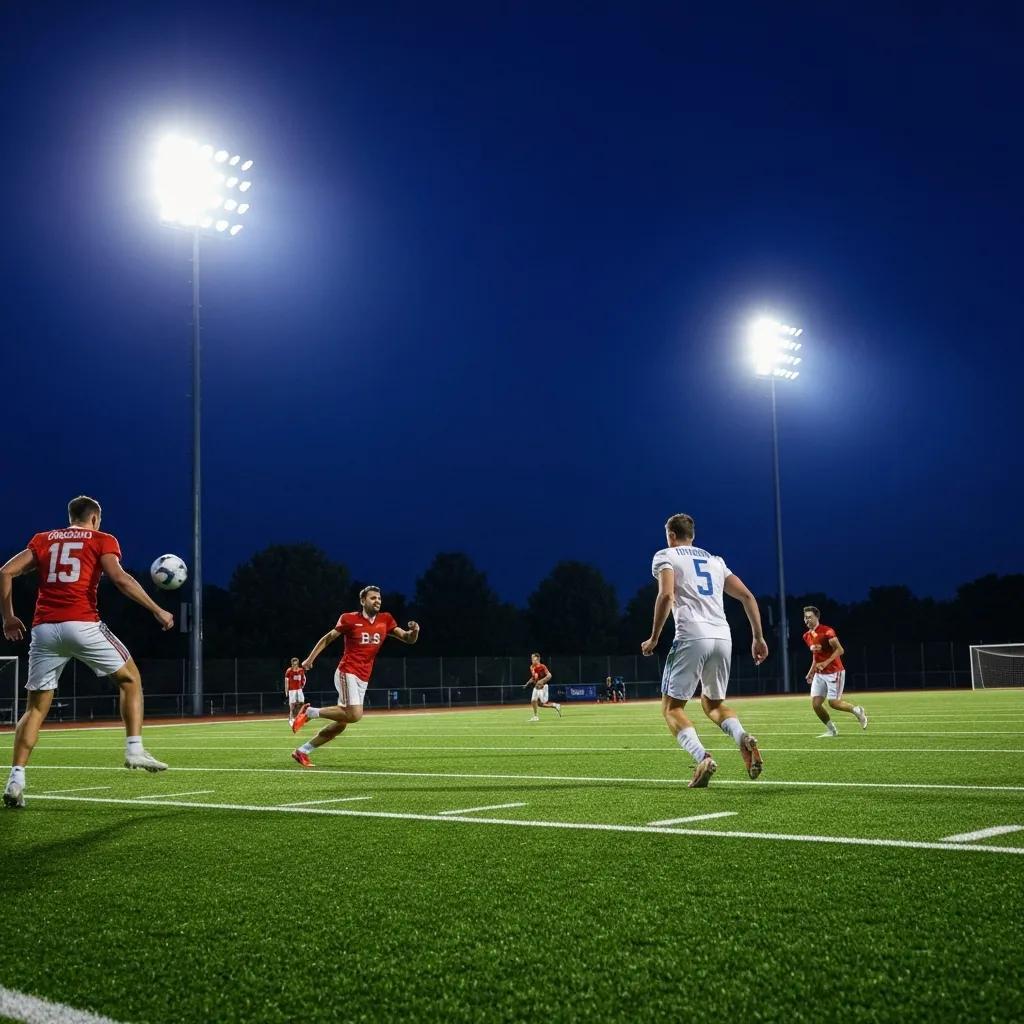
Football and soccer fields require even horizontal uniformity and sufficient vertical illuminance for players, referees, and broadcasts. Recreational fields typically target 75–150 lux, while competitive or broadcast venues aim for 200–500 lux with tighter uniformity. Perimeter or high-mast poles, asymmetric beam patterns, and precise aiming reduce shadows, enhance depth perception, and maintain spectator safety. Proper optics and pole selection minimize rework and ensure consistent play conditions.
How Should Tennis, Pickleball, and Baseball Courts Be Lit?
Court sports require strong vertical illuminance for ball tracking, with vertical lux targets specified alongside horizontal levels. Tennis and pickleball typically need 200–300 lux, using lower pole heights to optimize vertical distribution. Baseball requires higher infield illuminance with glare control for pitchers and batters, while outfields use broader beams and careful aiming. Asymmetric optics and shielding manage spectator glare and limit light spill. Properly translating these requirements into pole layouts and beam choices ensures accurate design and fixture selection.
Illuminance uniformity of outdoor sports lighting. For example, for IES Class I football fields, Metric units may be employed (that is, lux and meters), or US customary units may be used. The percentage of the fields that failed to meet the uniformity requirements of RP-6 is discussed.
Illuminance uniformity of outdoor sports lighting, KW Houser, 2011
How Much Does Outdoor Sports Lighting Cost and What Is the ROI?
Project costs are driven by several discrete components: fixtures, poles and foundations, electrical infrastructure, controls, and labor, making a transparent cost breakdown essential for ROI forecasting. An ROI calculation typically sums first-year energy and maintenance savings and divides them by total project cost to estimate simple payback, while a more sophisticated model includes net present value (NPV) and lifecycle cost analysis. Light Disty can assist with ROI modeling and energy savings projections. Example estimates and a cost-driver table below can help facilities create preliminary budgets and compare retrofit versus full replacement scenarios. Use conservative savings assumptions and include commissioning and measurement to protect projected returns.
| Project Component | Cost Driver | Typical Range / Example |
|---|---|---|
| Fixtures | Quality, lumen package, optics | Moderate–High |
| Poles & Foundations | Height, foundation type | Moderate |
| Controls & Wiring | Zoning, dimming, smart systems | Low–Moderate |
What Factors Influence the Cost of Sports Lighting Installation?
Several factors determine total project cost:
- Number and lumen output of fixtures.
- Pole heights and foundation complexity.
- Trenching and electrical upgrades.
- Control system complexity, including networked dimming.
- Site access, staging constraints, and existing infrastructure (conduits, transformers, civil works).
- Fixture quality and precision optics affect both upfront costs and long-term energy and maintenance savings.
Early site audits and phased planning help reduce change orders and ensure accurate vendor estimates, enabling investments with measurable ROI.
How Can You Calculate ROI for Energy-Efficient LED Upgrades?
Use the simple payback formula: Annual Savings (Energy + Maintenance) ÷ Total Project Cost = Payback Years. Example: $150,000 retrofit ÷ $30,000 annual savings = 5 years.
For detailed analysis, compute lifecycle costs over 10–20 years, include utility rebates, and discount future savings to calculate NPV. Factor in maintenance savings from fewer relamping cycles and reduced labor to improve accuracy. Conduct metering and post-commissioning verification to confirm actual savings. Use ROI data to explore funding, rebates, and financing options to improve upfront affordability. Professional services offering project estimation, ROI modeling, and verified savings projections support informed decisions and accelerate procurement.
What Funding and Grant Options Are Available for Sports Facility Lighting?
A mix of funding options commonly supports sports lighting projects: utility rebates for energy-efficiency upgrades, municipal or state grants for community recreation improvements, federal energy programs where applicable, and financing mechanisms that spread capital cost. Eligibility and availability vary by jurisdiction and program; facilities should document baseline energy use and proposed savings to maximize incentive capture. Combining multiple funding sources rebates, grants, and financing often yields the most affordable path to retrofit or replacement. Below is a concise list of common funding types to guide initial outreach and program discovery.
- Utility rebates and incentives that require pre-approval and measured savings.
- Local or state recreational facility grants are targeted to community improvement.
- Third-party financing or energy service agreements that monetize projected savings.
Facilities that prepare robust savings documentation and partner with experienced providers increase their chances of securing these funds.
Which Grants and Financing Programs Support Sports Lighting Projects?
Typical support programs include utility-run incentive offerings for LEDs and controls, municipal recreation capital grants that prioritize community access, and sometimes state energy offices that fund efficiency upgrades. Each program has eligibility rules; some require pre-installation approval, measurement and verification, or specific product lists, so early engagement with program administrators is crucial. Facilities should compile an energy audit, baseline usage data, and an engineered savings estimate to qualify for higher-value rebates. Working with a provider that understands local incentive pathways streamlines application and compliance tasks. Understanding program requirements ahead of time minimizes delays and preserves incentive eligibility during procurement.
How Can Facilities Maximize Funding Opportunities for LED Lighting?
Facilities can maximize funding opportunities for LED lighting by performing an energy audit, documenting existing conditions, and securing multiple quotes with verified savings. Clear project metrics, schedules, and measurement plans strengthen grant applications, while demonstrating community benefits such as increased recreational hours or improved safety adds credibility. Partnering with experienced consultants helps navigate rebates, grants, and financing, ensuring pre-approvals, accurate documentation, and smooth integration of funding into project planning. Engaging support early reduces administrative burden and preserves incentive eligibility.
How Do You Choose the Right Partner for Outdoor Sports Lighting Installation?
Selecting a partner requires assessing technical design capability, documented experience with sports venues, commissioning and measurement practices, warranty coverage, and post-installation support. A full-service provider who delivers consultation, lighting design, supply, and installation reduces coordination gaps and improves accountability across phases. Look for providers that use standards-based design (IES practices), provide simulation deliverables, commit to on-site aiming and verification, and offer long-term performance warranties. A structured procurement checklist ensures you compare apples-to-apples proposals and prioritize long-term performance over the lowest initial cost.
Why Is Expert Consultation Critical for Sports Lighting Success?
Expert consultation prevents common pitfalls such as under-designed uniformity, excessive glare, inadequate vertical illuminance, or incompatible control systems that undermine expected savings. Experienced designers use photometric simulation and IES-based calculations to size fixtures, optimize aiming and produce commissioning plans that confirm field performance. Consultants also help navigate code compliance, light pollution regulations and utility incentive requirements, reducing the risk of rework. Engaging expertise earlier in the process shortens procurement cycles and results in systems that meet play, spectator, and broadcast needs reliably.
What Should You Look for in a Sports Lighting Provider?
When selecting a sports lighting provider, look for documented experience with similar venues, standards-based design capability, clear warranty and maintenance terms, and structured commissioning plans. Review photometric simulations, references, and a scope that separates design, supply, and installation. Confirm networked controls, post-installation verification, and performance-based acceptance criteria. Engaging a qualified partner ensures reliable, glare-controlled, and energy-efficient lighting while reducing project risk.
Conclusion
Upgrading to LED sports lighting delivers energy savings, lower maintenance costs, enhanced player performance, and improved spectator experience. Careful planning, sport-specific design, smart controls, and selecting a capable provider ensure optimal results and a strong return on investment, making modern LED systems a cost-effective and sustainable choice for any facility.